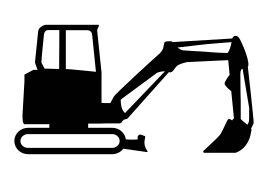
Compact Excavator Basics
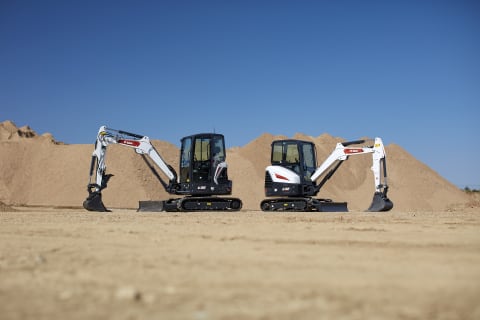
Compact excavators are powerful digging machines. They are also known as mini excavators, but don't underestimate them. The advanced hydraulic systems often outperform larger tractor loader backhoes, and they offer greater flexibility to place spoil or load a truck.
Compact Excavator Components
As you compare compact excavator models, it's important to understand their key components:
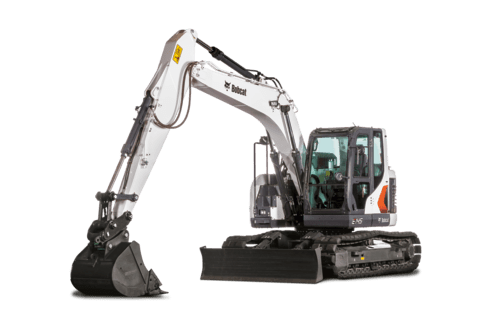
- House: Contains the operator's compartment, engine and hydraulic pump and distribution components. The house and workgroup "slew" (rotate) 360 degrees on the undercarriage.
- Undercarriage: The legs and feet of the compact excavator. Rubber or steel tracks surround the drive sprockets, rollers and idlers that propel the machine.
- Workgroup: The boom, dipper (or arm) and an attachment. Buckets are most common, but more than 15 attachments are commonly available.
- Backfill blade: Used for grading, leveling, backfilling, trenching and dozing. Depending on its position, it can be used as a stabilizer for the machine.
Access for Tight Work Areas
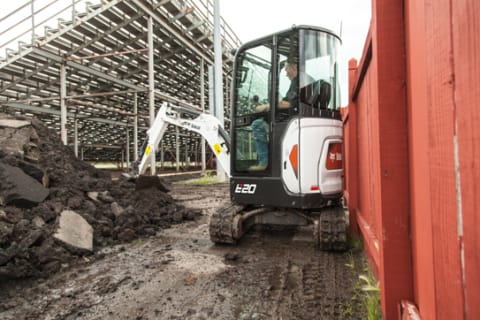
Retractable undercarriages are common on smaller compact excavators. The H-shaped design can be retracted to temporarily reduce machine width. It's valuable when you travel through fence gates and other tight areas. The tracks can then be expanded to increase your digging power.
Most compact excavators come with a fixed undercarriage, which is slightly wider than the house structure on most machines.
Flexible, Powerful Digging
Most compact excavators are equipped with a swing boom that's connected to a swing frame. It pivots left or right (independent of the house) and it can move up or down. Because of its off-center mount, you can easily see the bucket and hole. It's more versatile and productive than fixed boom or knuckle boom configurations.
Excavators also feature different arm configurations. A standard arm has the best balance of machine weight, digging depth and track power. Long arm models offer more reach and dump height to reduce repositioning and increase productivity. An extendable arm adds dump height and reach beyond long arm configured machines. When it's retracted, it acts like a standard arm machine.
Tail Swing Configurations
Tail swing refers to the rear overhang of the house as the compact excavator rotates on the undercarriage. Different configurations offer choices for lift capacity, maneuverability and spoil placement.
- Conventional tail swing: The rear of the house protrudes 6 inches or more beyond the width of the tracks through slew rotation. When comparing tail swing variations of a similar size machine these models typically offer the greatest lift capacity, but the ability to rotate and place spoil can be limited if working in tight spaces. Also, when comparing similar sized models, a conventional tail swing excavator will generally have a narrower stance (width), affording improved access through doorways, gates, property lines or other restrictions.
- Minimal tail swing: The rear of the house protrudes as much as 6 inches beyond the width of the tracks. When working in tight spaces, minimal tail swing models provide improved flexibility, to slew and deposit spoil.
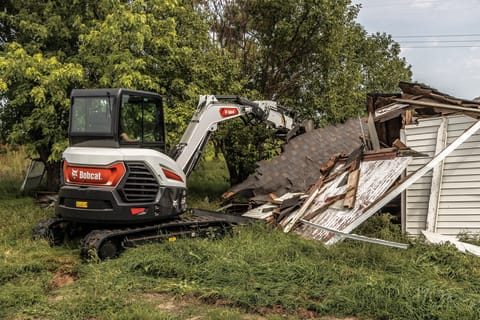
- Zero tail swing: The rear of the house stays within the width of the tracks through full rotation. It offers the greatest flexibility to slew and deposit spoil, and affords the greatest protection against inadvertent contact with surround objects.
In-Track Swing Frame helps you rotate the house with more confidence in tighter areas. Watch this simple comparison to see it in action.
Compact Excavators Versus Tractor Loader Backhoes
Compact excavators offer many advantages over traditional center-mount backhoes:
- Better rotation: Compact excavators can continuously rotate 360 degrees for unlimited spoil placement. A backhoe, in contrast, has a maximum of 180 degrees of workgroup movement.
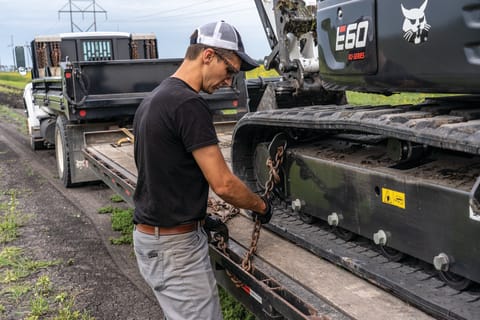
- Time and fuel savings: Compact excavators use less fuel and can be hauled with lighter, more fuel-efficient trucks, keeping your hourly costs down.
- More flexibility: When you work next to objects, an excavator provides much more flexibility. On many job sites, a tractor loader backhoe is limited to only 45 degrees of workgroup movement. In similar situations, a compact excavator may have up to 180 degrees of movement—allowing you to place spoil where needed, or even load a truck behind the machine.
- Powerful digging: The hydraulic systems on compact excavators often outperform larger machines.
- Better visibility: In a compact excavator, you sit offset relative to the boom for an unobstructed view of the attachment. On a tractor loader backhoe, you constantly have to lean around the boom to see the attachment.
- Offset digging: With the independent boom swing of a compact excavator, you can dig offset. Access each side of buried utility line or dig square holes without repositioning the machine.

S70
S100
S130
S150
S160
S510 M-Series
S175
S550 M-Series
S185
S530 M-Series
S570 M-Series
S205
S590 M-Series
S630 M-Series
S650 M-Series
S750 M-Series
A770 All-Wheel Steer
S770 M-Series
S850 M-Series
T110
T180
T190
T550 M-Series
T590 M-Series
T630 M-Series
T650 M-Series
T750 M-Series
T770 M-Series
T870 M-Series
MT52
MT55
418
324
E26 M-Series
E32 M-Series
E35 M-Series
E42 M-Series
E45 M-Series
E50 M-Series
E55 M-Series
E60 M-Series
E80 M-Series
V417
Loader
Excavator
Telehandler
Utility Vehicle
Toolcat™
Compact Tractor
CT122
CT225
CT230
CT235
CT335
CT440
CT445
CT450
3450 4x4
3400XL 4x4
3400 4x4
3200 4x2
5600
5610