- Hogar
- Compra de recursos
- Cortadoras de césped
- How Do Zero-Turn Mowers Work?
HOW DO ZERO-TURN MOWERS WORK?
Why it matters.
Understanding how zero-turn mowers function is pivotal in making an informed buying decision, developing a consistent upkeep and maintenance routine, and ultimately assuring proper turf maintenance. Below you’ll find information regarding what a zero-turn mower is, how it functions, how it takes on various challenges and what applications zero-turn mowers are best suited for.
What makes a “zero-turn” a zero-turn?
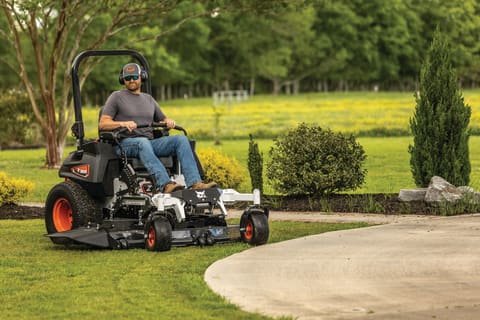
A “zero‑turn” mower gets its name from its ability to pivot within its own footprint, delivering a true zero‑degree turning radius. Instead of steering like traditional ride‑on mowers (garden tractors) with a steering wheel, zero‑turn mowers use independently controlled rear wheels powered by hydraulic drive systems and its own transaxle.
Because each rear wheel can move at a different speed, or rotate in opposite directions, the mower can turn in place without moving forward or backward. This allows the mower to make tight 180‑degree turns at the end of a pass and even rotate a full 360 degrees "on a dime" when needed. The result is exceptional maneuverability around trees, landscaping, and other obstacles with minimal repositioning.
By eliminating wide turnarounds and unnecessary repositioning, zero‑turn technology allows for smoother mowing patterns, fewer passes, and reduced overall mowing time. This helps maintain a clean, professional‑looking cut while improving overall efficiency.
How is this different from a garden tractor or walk-behind mower?
The key point of differentiation between a zero-turn mower and a garden tractor or walk-behind mower is the turning radius. Whereas the mechanics of a zero-turn mower allow for a pivot within the machine’s footprint:
A garden tractor requires a standard T-turn to reverse or change direction for a full 180-degree turn-around. This may prove challenging in tight spaces or highly landscaped areas.
A walk-behind mower naturally offers the ability to pivot, however propulsion comes from the operator pushing and turning the mower physically and doesn’t offer the same comfort features as a zero-turn mower.
Key Components of a Zero-Turn Mower
Dual hydrostatic drive system
A dual hydrostatic drive system uses two independent hydraulic drives, one for each rear wheel, to control speed and direction. By varying hydraulic flow to each wheel independently, the mower can move forward, in reverse, turn smoothly or pivot in place. The system affords the operator precise control, smooth operation and consistency in power.
Drive and caster wheels
The drive wheels on a zero-turn mower are the two, larger back wheels and are powered through the hydrostatic drive system. Their primary responsibility is to provide propulsion for the mower. The front caster wheels are unpowered and swivel freely, supporting the front of the mower, allowing it to pivot smoothly when changing direction.
Control Levers
The left and right traction control levers (or bars) on a zero-turn mower replace the steering wheel and are required to achieve a true zero-turn pivot as each lever controls one drive wheel.
Cutting Deck
The cutting deck houses the blades and manages airflow to lift, cut and discharge grass cleanly and evenly. It’s positioned centered beneath the mower, keeping the center of gravity low and to provide for balanced cutting.
How does steering and movement work?
A zero‑turn mower uses traction control levers to control steering and movement rather than a traditional steering wheel.
The zero-turn mower is disengaged when the traction control levers are open, allowing the operator access to the seat. Steering and movement begin when the operators engage the traction control levers by pulling the levers inward, engaging the drive system.
Pushing both levers forward moves the mower straight ahead, while pulling them back reverses the mower. Moving one lever more than the other causes the mower to turn, right or left. Pushing one lever forward while pulling the other back allows the mower to pivot in place. This independent control of each rear wheel gives the operator control over speed and direction.
See the operation in action in our Turf Talks video with easy-to-follow step-by-step instructions.
How are power and transmission related?
On a zero-turn mower, the engine generates power that is divided between the cutting deck system and the drive system. Power is transferred from the engine to the cutting deck blades through belts or electric motors, allowing the blades to spin at high speed for consistent cutting.
Simultaneously, engine power is sent to the two independent hydrostatic transmissions, which regulate how that power is applied to each rear wheel for smooth, variable speed control. By controlling wheel speed and direction independently, the transmission system converts engine power into smooth, variable movement and precise steering control.
What Are the Advantages of a Zero-Turn Mower?
Zero-turn mowers offer a wealth of advantages when compared to a garden tractor or walk-behind mower.
Faster Mow Times
Purely from an engineering and power standpoint, zero-turn mowers are generally able to mow at faster speeds than traditional garden tractors, and certainly faster than the manual walk-behind push mower. This is especially advantageous when maintaining large properties and big acreage. Additionally, the larger deck sizes some zero-turn mowers accommodate mean fewer passes and less time to complete a job.
Superior Maneuverability
A zero-turn mower is superior for maneuverability because it uses independent drive wheels instead of a front-steering axle like a garden tractor. Each rear wheel can move at a different speed, or in opposite directions, allowing the mower to pivot within its own footprint. This eliminates wide turns, reduces back-and-forth maneuvering and lets operators cut closely around trees, beds and obstacles with fewer passes.
Cleaner, More Consistent Cut
A zero-turn mower delivers a cleaner, more consistent cut because it maintains steady blade speed and precise control at higher ground speeds. Its maneuverability allows operators to mow smoothly around obstacles without stopping, slowing or overlapping passes, which reduces uneven cutting and scalping. Combined with advanced deck airflow and stable weight distribution, zero-turn mowers cut more evenly and efficiently than garden tractors or walk-behind mowers.
Operator Comfort
- Most zero-turn mowers outperform walk-behind mowers and garden tractors when compared for operator comfort due to:
- Premium seat offerings - most zero-turns offer padded seats, weight adjustments and suspension systems that make for a smoother ride
- Vibration dampening features - Most zero-turn mowers are equipped with anti-vibration features like foot mats or plates
- Reduced physical strain - Garden tractors take more effort to steer and are slower to react to operator steering. Walk-behind mowers, by the nature of their design, need to be pushed which takes a toll on the operator’s back and legs.
Durability
Zero-turn mowers are generally more durable because they are built with heavier-duty frames, reinforced cutting decks and commercial-grade engines designed to handle higher speeds and longer operating hours. Compared to walk-behinds and most garden tractors, they typically use stronger structural components and more robust transmissions to withstand rough or demanding terrain.
Applications
From college campuses to city parks, large acreage properties to whole municipalities, the application for zero-turn mowers is nearly limitless.
To learn more about the various commercial and residential capabilities and applications for zero-turn mowers, discover the applications and uses of zero-turn mowers. Additionally explore the zero-turn mowers buyers guide, a comprehensive review of our various platforms and what industries the zero-turn mowers are best suited for their usability.
Contine Your Mower Journey
Zero-turn mowers achieve efficiency by using independent hydrostatic drives for each rear wheel, allowing precise control of speed and direction without stopping or repositioning. Operators can smoothly vary wheel speed or reverse one wheel entirely to make tight turns and pivot in place, eliminating wasted passes and overlap. The hydrostatic system delivers continuous, smooth power without shifting, letting the mower maintain momentum, cut faster around obstacles and finish jobs in less time.
Finding and purchasing a zero-turn mower isn’t an impulse decision, especially when you consider your unique set of circumstances and challenges. To learn more about Bobcat zero-turn mowers consult your nearest authorized Bobcat dealer or continue your mower journey with the following resouces.
- Mower Comparison Chart - A quick comparison of specifications on Bobcat zero-turn mowers
- Bobcat Zero-Turn Buyers Guide - A comprehensive look at Bobcat’s zero-turn mower lineup.
- What size zero-turn mower is right for me? - An overview of the factors impacting finding the ideal zero-turn mower.
- Differences Between Bobcat Zero-Turn Mower Platforms - A guide comparing the Bobcat mower platforms.
- Bobcat Turf Talks - A helpful video series for seasonal maintenance, tips-and-tricks and general operation.
- Bobcat Advantage: Mowers - A video series examination of the features that give Bobcat mowers the competitive edge.