- Home
- News, Media & Fairs
- Press Releases
- Bobcat is Entering the European Wheel Loader Market
Bobcat is Entering the European Wheel Loader Market
Posted: 21 October 2020
To expand the company’s loader product portfolio and to strengthen the company’s position as the world leader in compact equipment, Bobcat is entering the European wheel loader market for compact wheel loaders and small articulated loaders. The company is expanding its loader portfolio to provide customers with more choice of Bobcat products, with optimized characteristics for specific applications in construction, rental, agriculture, landscaping, road works, material handling and many other industries.
To recap, the current Bobcat loader line-up in Europe is based on Skid-Steer Loaders (SSL), Compact Track Loaders (CTL), Mini-Track Loaders (MTL) and Telescopic Loaders (TL). Now, Bobcat is extending the range with Compact Wheel Loaders (CWLs) and Small Articulated Loaders (SALs).
New Compact Wheel Loaders (CWLs)
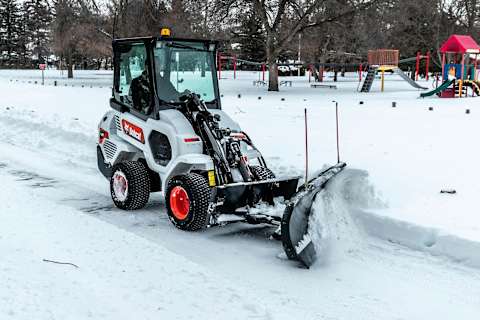
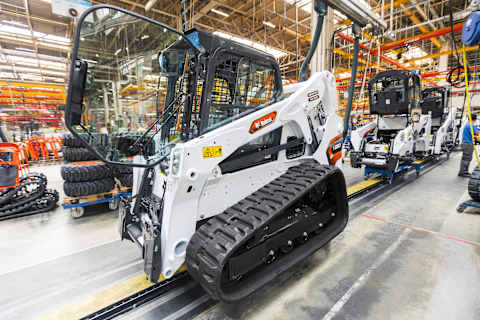
Bobcat is entering the CWL market with two models: the L65 and L85. Designed and built by Bobcat at the company’s campus in Dobris in the Czech Republic, the L65 and L85 CWLs set a new market-leading performance benchmark in this segment. Bobcat CWLs are mainly aimed at the construction and rental markets, but are also ideal for road work, snow removal, maintenance and many other applications.
Compact Wheel Loader Range
Jiri Karmazin, Loaders Product Manager at Bobcat, said: “With our new CWLs, you can get any job done thanks to the combination of a powerful Bobcat engine and a well-balanced hydraulics system. Bobcat CWLs can also be adapted to different applications with a wide range of Bobcat-approved attachments. The Bobcat CWL range is built using well proven components, renowned suppliers and processes used in other Bobcat products.”
New Small Articulated Loaders (SALs)
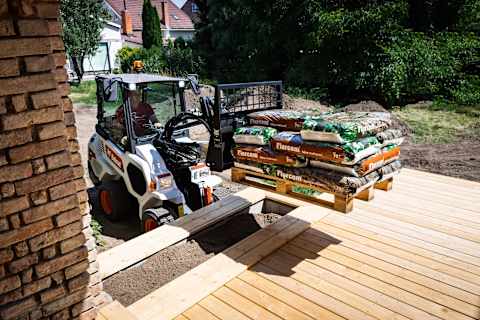
Bobcat is also entering the SAL market with two models, the L23 and L28, designed and built by the company in Bismarck in North Dakota, USA. With the new Bobcat SALs, the traditional attributes of high performance in a compact size, agility and versatility are now complemented by a light touch on the ground and increased lift capacity for lower weight machines. All of this is provided in comfortable, easy-to-drive vehicles that are also easily transported by trailer.
Bobcat SALs achieve very minimal ground disturbance with their use of an articulated joint, which enables the rear tyres to match the front tyre path when turning. In addition, the turf-safe mode limits wheel slippage. This makes Bobcat SALs ideal for landscaping, light construction, agriculture and maintenance projects where space is tight and lower ground contact is needed.
Small Articulated Loader Range
John Chattaway, Loaders Product Manager at Bobcat, said: “The high lift capacity offered by Bobcat SALs compared to their machine weight is ideal for lift and carry operations in compact areas. The extendable boom on the L28 further simplifies the placement of loads which is also enhanced by the all-round visibility. Counterweight options allow our SALs to be customized to give users the capacity they need for a particular application.”
Bobcat will be providing more detailed specifications of the CWL and SAL ranges at the commercial launch date, which is planned for early 2021.
READ MORE
View all- Telehandlers in Farming: Lifting Bales, Stacking Hay, and Loading Feed
Telehandlers in Farming: Lifting Bales, Stacking Hay, and Loading Feed
9 June 2026
How telehandlers improve bale stacking, hay storage, and feed loading on farms: attachments, building access, soft ground, and Bobcat V-Drive transmission. - Applications of Rotary Telehandlers in Construction and Industrial Settings
Applications of Rotary Telehandlers in Construction and Industrial Settings
2 June 2026
Where rotary telehandlers add value in construction and industry: facade work, roof loading, precast placement, maintenance, and when a crane or MEWP is better. - What Are Rotary Telehandlers?
What Are Rotary Telehandlers?
28 May 2026
What rotary telehandlers are, how the 360-degree turret, stabilizers, and dynamic load charts work, and which jobs justify their higher cost and complexity. - Choosing the Right Telehandler Size and Attachment Set for Construction, Warehousing, or Agriculture
Choosing the Right Telehandler Size and Attachment Set for Construction, Warehousing, or Agriculture
25 May 2026
A four-step method for choosing telehandler size and attachments for construction, warehousing, or agriculture: capacity, site dimensions, hydraulics, and V-Drive. - Safety Tips for Operating Telehandlers and Choosing the Right Capacity
Safety Tips for Operating Telehandlers and Choosing the Right Capacity
20 May 2026
Practical telehandler safety tips: pre-use inspection, ground assessment, load charts, stabilizers, and how to choose the right capacity from your critical lift. - Key Attachments for Telehandlers (Buckets, Forks, Winches) and Their Use Cases
Key Attachments for Telehandlers (Buckets, Forks, Winches) and Their Use Cases
18 May 2026
A practical guide to telehandler attachments: forks, buckets, bale handlers, jibs, winches, sweepers, and work platforms, and how to match them to your daily tasks. - Telehandler vs. Forklift: Compare Lift Capacity, Height Reach, and Maneuverability
Telehandler vs. Forklift: Compare Lift Capacity, Height Reach, and Maneuverability
14 May 2026
Compare telehandler and forklift lift capacity, height, reach, and maneuverability, from load charts and stabilizers to steering modes and real site performance. - Telehandler vs. Compact Tractor with Front-End Loader for Bale Handling
Telehandler vs. Compact Tractor with Front-End Loader for Bale Handling
14 May 2026
Telehandler vs. compact tractor with front-end loader for bale handling: lift height, reach, stability, attachments, building access, and total cost of the job. - Telehandler vs. Forklift for Lifting and Placing Materials on Construction Sites
Telehandler vs. Forklift for Lifting and Placing Materials on Construction Sites
14 May 2026
Compare telehandlers and forklifts for construction sites: ground conditions, reach, accurate placement at height, attachments, and a job-by-job decision table. - Standard vs. Rotary Telehandlers: Explain 360-Degree Rotation, Crane-Like Capability, and Suitable Jobs
Standard vs. Rotary Telehandlers: Explain 360-Degree Rotation, Crane-Like Capability, and Suitable Jobs
14 May 2026
Standard vs. rotary telehandlers: what continuous 360-degree rotation adds, how dynamic load charts and stabilization work, and which jobs justify the higher cost.