- L100 Compact Wheel LoaderNew
L100 Compact Wheel Loader
Our most capable compact wheel loader combines flexible configurations and intuitive controls to maximize daily job site productivity.
Display Full Product DetailTipping load3752 kgEngine power55.2 kWOperating weight5258 kg - L85 Compact Wheel Loader
L85 Compact Wheel Loader
Bobcat's L85 Compact Wheel Loader leads the pack in performance, versatility, and maneuverability.
Display Full Product DetailTipping load3151 kgEngine power50.7 kWOperating weight5091 kg - L85 Compact Wheel Loader (2026 Update)New
L85 Compact Wheel Loader (2026 Update)
Handle demanding material loading in restricted spaces with the agile Bobcat L85 Compact Wheel Loader.
Display Full Product DetailTipping load3142 kgEngine power50.7 kWOperating weight4796 kg - L95 Compact Wheel Loader
L95 Compact Wheel Loader
Bobcat's most powerful Compact Wheel Loader combines high performance with top-of-the-line tech and smooth operation.
Display Full Product DetailTipping load3339 kgEngine power55.2 kWOperating weight5316 kg
Choosing a Compact Wheel Loader
Decide whether a compact wheel loader fits your work, compare it with other Bobcat loaders and telehandlers, and find the right guide for your next step.
- Home
- Buyer's Guides
- Choosing a Compact Wheel Loader
A compact wheel loader is built for repeated loading, carrying, and placing between a stockpile, a delivery point, and a storage bay on firm ground. Articulated steering keeps travel smooth on repeated routes, and quick attachment changes let you switch between buckets, pallet forks, and snow pushers.
For pivot turns in very tight spaces, high stacking, or deep mud, compare a skid-steer loader, a telehandler, or a compact track loader.
I’m new to compact wheel loaders
Learn how compact wheel loaders work, where they perform best, and how they handle tight urban sites.
I’m comparing machine types
Compare compact wheel loaders with telehandlers, skid-steer loaders, small articulated loaders, or another machine before choosing.
I’m comparing specifications
Understand travel speed, turning radius, operating weight, and bucket capacity before comparing models.
I need attachments
Choose attachments based on the job, material density, hydraulic requirements, and working conditions.
Discover More Articles About Compact Wheel Loaders
12 Results
12 Results
Compact Wheel Loader vs. Telehandler vs. Skid-Steer Loader: Lift Height, Bucket Capacity, Versatility and Best Use Cases
Compare compact wheel loaders, telehandlers, and skid-steer loaders by reach, carrying, turning, attachments, ground conditions, and real job cycles.
Small Articulated Loader vs. Skid-Steer Loader vs. Compact Wheel Loader: How to Choose
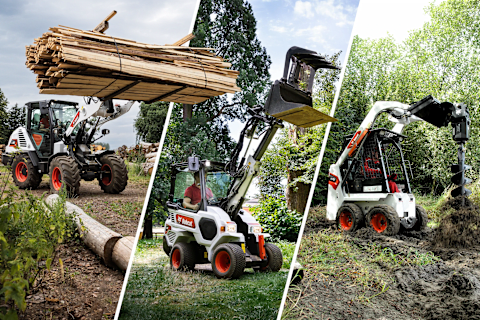
Compare small articulated loaders, skid-steer loaders, and compact wheel loaders by surface, access, loading cycle, attachments, and running cost.
Compact Wheel Loader Service Manuals, Parts Diagrams and Technical Downloads
Find the correct Bobcat operator manual, maintenance schedule, parts catalog, diagram, or service information by model, serial number, and task.
Financing, Leasing, Renting or Buying a Compact Wheel Loader: Costs, Requirements and Utilization Thresholds
Compare renting, leasing, buying new, and buying used through utilization, availability, attachments, maintenance, downtime, and condition risk.
How to Compare Compact Wheel Loader Specifications: Travel Speed, Turning Radius, Operating Weight, and Bucket Capacity
Understand bucket capacity, rated capacity, travel speed, turning radius, operating weight, hydraulics, and configuration before comparing loaders.
Predictive Maintenance for Compact Wheel Loaders: Sensors, Telematics, and Bobcat Machine IQ
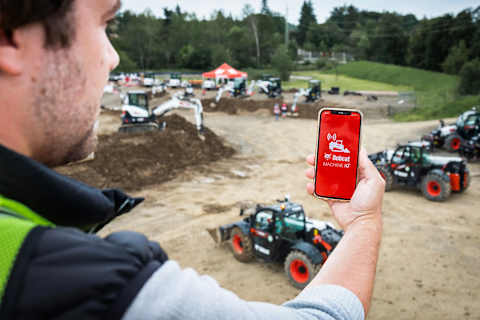
Understand what Machine IQ can monitor, how telematics supports maintenance, and why alerts still require inspections, diagnosis, and ownership.
Compact Wheel Loader Attachments for Agriculture: Farm Work, Silage Handling and Feeding
Choose compact wheel loader attachments for feed, silage, manure, pallets, cleanup, and bale work while checking capacity and barn access.
Compact Wheel Loader vs. Telehandler for Feed Distribution and Barn Work: Maneuverability, Lift Height, Capacity
Compare compact wheel loaders and telehandlers for bales, feed, barns, reach, visibility, capacity, ground conditions, and daily farm cycles.
Compact Wheel Loaders for Tight Urban Construction Sites
Measure access, turning space, headroom, surface limits, and pedestrian routes before choosing a compact wheel loader for an urban site.
Compact Wheel Loader Attachments for Material Handling, Snow Removal, Construction and Landscaping
Match Bobcat compact wheel loader buckets, forks, snow tools, sweepers, and powered attachments to the material, route, hydraulics, and job.
What Is a Compact Wheel Loader and What Is It Used For?
Learn what compact wheel loaders do best, how articulated steering changes the job, and when another loader or telehandler is a better fit.
The Dig Gets His Claws into a Bobcat CWL
Construction Plant News: All we know is that we call him The Dig. This month he gets his claws into a Bobcat CWL.
Compare compact wheel loader models
Compare Bobcat compact wheel loader models, check specifications, or contact your local dealer for help matching a machine to your work. When comparing Bobcat compact wheel loader models, focus on articulated tipping load, operating weight, travel speed, hydraulic flow, attachment requirements, and jobsite conditions.
Compact wheel loader FAQs
How does a compact wheel loader steer differently from a skid-steer loader?
A compact wheel loader steers by bending the chassis at a central articulation joint, meaning it follows a curved turning arc and the wheels roll naturally over the ground. A skid-steer loader turns by independently changing the wheel speed on each side of the machine, allowing it to pivot on the spot within a fixed area. The wheel loader is generally the better choice for longer load-and-carry routes and working on finished surfaces where tire scrubbing must be minimized. The skid-steer loader excels in highly confined, attachment-led tasks.
Can a compact wheel loader effectively replace a telehandler?
Only for operations strictly close to ground level. A compact wheel loader moves pallets and loose bulk material highly efficiently, but its fixed Z-bar or parallel loader arms cannot physically match a telescopic boom for high-level stacking or reaching forward across obstacles. If high placement is an occasional requirement, a compact wheel loader can serve as your primary machine, supplemented by a rented telehandler. If high stacking is a daily necessity, the operational case for owning a telehandler is much stronger.
Does bucket volume indicate how much weight a compact wheel loader can lift?
No. Bucket capacity strictly measures volume, not payload weight. The actual weight you can safely carry depends entirely on the material density (e.g., dry soil versus wet gravel), the physical mass of the bucket itself, and the machine's geometric configuration. Always check the tipping load and Rated Operating Capacity (ROC) for your exact setup, and remember that safe capacities drop significantly when the machine is articulated. Size your bucket around the heaviest, densest material you will realistically handle.
How do I know if a compact wheel loader will fit my site?
Measuring the gate width alone is insufficient. You must measure the overhead entrance height, the overall length of the machine with your longest attachment fitted, the full swept path required when the articulated chassis turns, the raised clearance height of the attachment, and the necessary reversing space. The most reliable verification method is an on-site dealer demonstration: run one fully loaded cycle along your actual working route using the attachment you will deploy most frequently.
Can I use the attachments I already own for my skid-steer loader?
In many cases, yes. Bobcat compact wheel loaders can be configured with either the proprietary Bob-Tach™ system or an industry-standard Quick-Tach interface, and an approved adapter plate lets you use many existing compact attachments. However, physical mounting is only the first step. You must verify that the specific attachment is factory-approved for your wheel loader model, and that the auxiliary hydraulic flow, system pressure, electrical connections, and overall attachment weight are fully compatible. Your Bobcat dealer can confirm the exact combination.
What maintenance support does Bobcat provide for compact wheel loaders?
Support begins with clear daily inspection guidelines, comprehensive maintenance videos, and specific service schedules and parts charts matching your exact model and serial number prefix, as detailed in the Operation and Maintenance Manual. Your dealer can provide BobCARE planned maintenance contracts featuring Bobcat-trained technicians and genuine parts, while Bobcat Fluid Analysis can be integrated into the annual service. For connected machines, the Machine IQ system tracks engine hours and transmits automated maintenance reminders based on your selected subscription package. Telematics supports service planning but does not replace the daily walk-around check.
Disclaimer
This content is provided for general informational and guidance purposes only. It may not reflect the specific requirements, conditions, configurations, attachments, applications, terrain, weather, or operating environment relevant to every machine or situation. Any models, configurations, availability, features, and specifications mentioned are provided for illustrative purposes only and may vary by market, region, dealer, and time. Operators, owners, and customers should always assess the actual working conditions and refer to the applicable operator’s manual, service manual, technical documentation, safety instructions, and product specifications for the specific Bobcat model and equipment being used. They should also consult an authorized Bobcat dealer or qualified professional before making operational, maintenance, purchasing, or safety-related decisions.