- Home
- Buyer's Guides
- Product Comparisons
- Telehandler vs. Compact Tractor with Front-End Loader for Bale Handling
Telehandler vs. Compact Tractor with Front-End Loader for Bale Handling
Published on: 3 June 2026
Choosing between these machines requires evaluating your overall farm workload. While a compact tractor with a front-end loader serves as a versatile unit for towing, mowing, and PTO tasks, a telehandler is a specialized material handler engineered for superior lift, reach, and repetitive loading cycles.
In this article:
- How lift height and forward reach change bale stacking and trailer loading
- Where a compact tractor remains the more versatile and economical farm machine
- How attachments, access, terrain, and V-Drive affect the decision
Lift Height and Forward Reach
Lift Height and Forward Reach
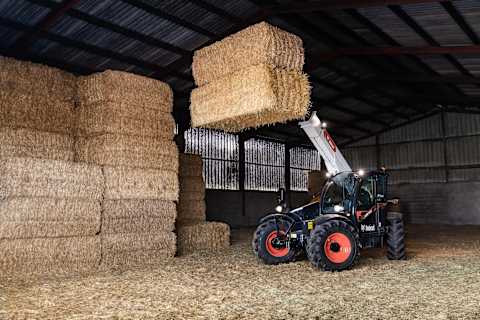
A compact tractor front-end loader raises the bale through a fixed arc. It works well for yard moves, low trailers, and moderate stack heights, but the tractor must stay close to the landing point.
A telehandler extends both upward and forward, allowing you to position the machine further from the stack, reach across trailer sides, and access deeper storage areas. This advantage becomes more pronounced as bale volume and stacking height increase.
Check the telehandler's load chart at the top and front of your stack. Rated capacity with the boom retracted is not the same as capacity at working height and reach.
Stability and Ballast
With a front-end loader, the bale sits ahead of the tractor's front axle. Correct ballast and the tractor-loader limits are essential, and slopes, soft ground, steering, and sudden movement become more critical as the load rises.
A telehandler features an integrated rear counterweight and a chassis purpose-built for material handling. Its four-wheel steering and low travel position enhance control; however, operators must still maintain low load positions, adhere to load charts, and avoid unstable terrain.
When comparing setups, consider the entire configuration. For tractors, account for the loader, rear ballast, attachments, tires, and payload. For telehandlers, evaluate the attachment, tire configuration, and boom positioning.
Attachment Choice for Different Bales
Choose a tube handler for wrapped round silage, where rounded hydraulic arms reduce the risk of piercing the film. Use forks, spikes, or tine handlers for unwrapped hay or straw when they suit the bale and machine.
While compact tractors support a wide range of attachments, their loader geometry can limit high or deep placement. In contrast, a telehandler can rapidly switch between bale handlers, forks, and buckets while maintaining its reach advantage.
Verify the Bobcat interface before sharing attachments. The TL25.60 utilizes Bob-Tach and accepts approved loader attachments, whereas larger agricultural telehandlers typically use Quick-Tach systems for telehandler-specific tools.
Daily Travel and V-Drive
A tractor is often the better choice if the machine spends the majority of the day towing trailers, mowing, or operating PTO-driven implements.
For intensive material-handling cycles, Bobcat's V-Drive agricultural telehandlers provide continuous acceleration from a standstill to road speeds without manual range shifts. Available on the TL34.65HF, TL38.70HF, and TL43.80HF, the V-Drive system includes:
- Cruise Control
- ECO-Ride to optimize engine rpm at steady travel speeds
- Stop & Start to reduce unnecessary idle time
- Maximum Speed Limiter
This technology results in smoother transitions between yard, shed, and road work. However, V-Drive does not convert a telehandler into a tractor or provide PTO capabilities.
Access to Barns and Feed Passages
Access to Barns and Feed Passages
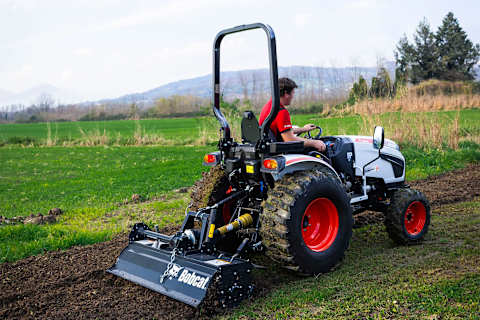
Before comparing performance, it is vital to measure your workspace. Compact tractors are often narrower and lower, whereas large telehandlers may struggle to enter older barns or narrow feed passages.
The Bobcat TL25.60 offers a compact telehandler solution, measuring just 1,840 mm wide and 1,930 mm high, while maintaining a 2,500 kg rated capacity and a 5.9 m lift height. Always verify doorways, roof trusses, turning radii, and floor loading for either machine.
If the machine cannot reach the work area, extra lift height has no value.
Which Machine Delivers Better Value?
Choose the tractor when bale handling is occasional and one machine must cover many non-lifting tasks. Choose the telehandler when material handling is a major daily workload and limited loader reach or repeated repositioning is costing time.
| Operating profile | Better starting point | Reason |
|---|---|---|
| Smallholding with occasional bales | Compact tractor front loader | Multi-purpose use and lower duplication |
| Regular mowing, PTO work, and towing | Compact tractor | Implements and drawbar work |
| High-volume bale stacking | Telehandler | Lift height, reach, and faster placement cycles |
| High-sided trailer loading | Telehandler | Forward reach over the side |
| Tight old buildings | Measure both; compact model may win | Physical access is decisive |
| Daily feeding and bucket work | Telehandler | Dedicated handling geometry and hydraulics |
| One machine must perform all farm tasks | Compact tractor | Broader non-handling capability |
Cost Factors Beyond Purchase Price
Compare the full cost of the job, not only the purchase price:
- Labour time per bale cycle
- Number of bales and seasonal peak hours
- Attachment and ballast costs
- Fuel and maintenance
- Transport and road use
- Building damage risk from limited visibility or clearance
- Whether one machine replaces or duplicates existing equipment
A used tractor and loader may be the economical answer for low utilisation. A telehandler can earn back its higher cost when reach, loading speed, and year-round feed or bucket work create enough productive hours.
Customer Experience
Real-Life Experience: Looking past the initial sticker price and calculating long-term labor and contract savings often makes a dedicated machine the more economical option. Poultry farmer David Derenne explains how a Bobcat telehandler justified its cost:
"When I compared the purchase price against the cost of hiring contractors for manure removal and chick unloading, the investment was clearly worthwhile. The machine also saves me time on other farm tasks. During peak periods, the telehandler runs up to 24 hours a day — I simply can't afford any downtime."
FAQ – Frequently Asked Questions
Can a compact tractor stack round bales safely?
Yes, within the tractor, front-end loader, attachment, ballast, and ground limits. Practical stacking height depends on the exact setup.
Why is a telehandler faster for high stacks?
Its telescopic boom combines height and forward reach, so you spend less time driving close to and repositioning beside the stack.
Does a telehandler need ballast?
It is designed with an integrated counterweight. Do not add unapproved ballast; use the machine within its load chart.
Is V-Drive available on the TL25.60?
No. V-Drive is offered on selected larger High Flow (HF) agricultural models.
Which machine is better on wet ground?
Neither machine is automatically safe on unstable ground. Always evaluate tires, total mass, axle loads, slopes, and soil bearing capacity.
Disclaimer
This content is provided for general informational and guidance purposes only. It may not reflect the specific requirements, conditions, configurations, attachments, applications, terrain, weather, or operating environment relevant to every machine or situation. Any models, configurations, availability, features, and specifications mentioned are provided for illustrative purposes only and may vary by market, region, dealer, and time. Operators, owners, and customers should always assess the actual working conditions and refer to the applicable operator’s manual, service manual, technical documentation, safety instructions, and product specifications for the specific Bobcat model and equipment being used. They should also consult an authorized Bobcat dealer or qualified professional before making operational, maintenance, purchasing, or safety-related decisions.