- Home
- Buyer's Guides
- Product Comparisons
- Telehandler vs Forklift: Which Is Right for Your Lifting Needs?
Telehandler vs Forklift: Which Is Right for Your Lifting Needs?
Published on 22 January 2026
Telehandlers and forklifts are both material-handling machines, but each excels in different scenarios. A telehandler is essentially a heavy-duty forklift with a larger footprint and telescoping boom, giving it crane-like reach. It is built for construction sites, farms, and other outdoor work where rough terrain and high lifts are common. In contrast, a forklift has a vertical mast and forks mounted on a compact chassis, optimized for lifting pallets or materials on flat, stable surfaces like warehouses and factories.
Customers often wonder, “Which is the right machine for my lifting needs?” The answer depends on factors like terrain, lift height, load type, and space. This article compares telehandlers vs forklifts – their construction, strengths, and best use cases – and even highlights how Bobcat’s machines address common user needs. By the end, you’ll know which equipment fits your job site and lifting requirements.
Quick Side-by-Side Comparison
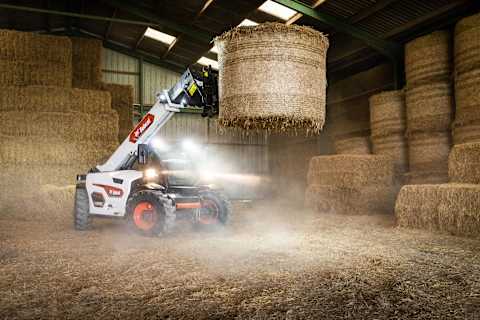
Telehandler – Best for…
- Rough, uneven terrain (construction sites, farms)
- Long reach & high lifts (placing loads at height or over obstacles)
- Heavy, bulky loads at elevation (bricks, lumber, hay bales)
- Wide range of attachments (forks, buckets, booms)
- Outdoor projects (construction, agriculture, landscaping)
- Higher purchase/rental cost, but more capability
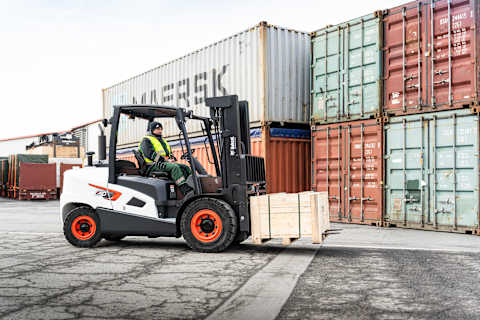
Forklift – Best for…
- Flat, smooth surfaces (warehouses, docks)
- Tight aisles and compact spaces (indoor stacking)
- Fast, repeatable pallet handling (truck loading, racking)
- Specialized pallet attachments (fork clamps, side-shifters)
- Indoor & outdoor facilities (warehouses, manufacturing)
- Lower cost and maintenance, electric models available
What Is a Telehandler?
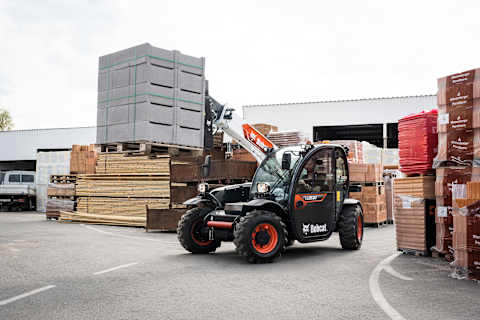
What Is a Telehandler?
A telehandler is a versatile lifting machine combining features of a forklift, crane, and loader. It has a telescoping boom in place of a fixed mast, allowing it to extend both vertically and horizontally to reach high or distant points. Most telehandlers run on diesel and are equipped with large rough-terrain tires and four-wheel drive, letting you operate on gravel, mud, or uneven ground. Commonly, telehandlers are used on construction sites or farms to move materials that a standard forklift cannot reach. For example, a telehandler can lift pallets of bricks to a second-story scaffold or load hay bales onto a trailer.
Typical telehandler uses: Construction (placing beams, bricks, and pallets at height), agriculture (lifting hay bales, feed bags, or moving manure), landscaping (moving soil or rocks), and other outdoor tasks. Bobcat telehandlers are go-to machines for farming, construction, landscaping, and snow removal, thanks to their extended reach and lift capacity. Telehandlers also support many attachment types – like buckets, jib cranes, or work platforms – making them machines capable of handling many jobs. In short, if you need to lift heavy or awkward loads high or over obstacles in challenging terrain, a telehandler is typically the right choice.
What Is a Forklift?
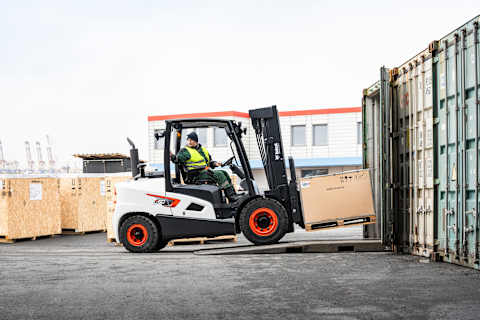
What Is a Forklift?
A forklift (lift truck) is a compact material-handling vehicle with a vertical mast and forks used to lift and transport pallets or other loads on flat surfaces. Forklifts come in various types: from small electric counterbalanced models for indoor use to larger diesel or petrol forklifts for outdoor yards, as well as cushion-tire or pneumatic-tire varieties. Their main strength is moving palletized goods quickly and repeatedly in tight spaces. For example, forklifts excel at stacking pallets in warehouses, loading trucks at a dock, or transporting heavy equipment in a manufacturing plant.
Typical forklift uses: Warehousing, manufacturing, shipping/receiving, and material yards. They are especially popular indoors because many models (such as electric or three-wheel forklifts) offer low emissions, reduced noise, and compact turning radii. In short, if your operations involve frequent pallet moves, rack stacking, or indoor shipping, a forklift is often your best choice. However, remember that forklifts are generally designed for stable, even ground and are not meant for rough terrain or extremely high lifts.
Head-to-Head Comparison
Terrain & Environment
-
Telehandlers: Built mainly for off-road work. Telehandlers usually have large, rough-terrain tires and four-wheel drive, giving them traction on mud, gravel, and uneven ground. They can often work on construction sites, farms, or any jobsite where the ground isn’t perfectly flat. Some telehandlers even have stabilizers to support heavy lifts on sloping terrain. Bobcat telehandlers use durable undercarriages and high ground clearance to help operators confidently work outdoors. For example, if your project involves moving material across a muddy yard or uneven hillside, a telehandler’s design means it will deliver better traction and stability than a forklift.
- Forklifts: Optimized for flat, indoor use. Most forklifts have smooth cushion tires or standard pneumatic tires and are designed to be driven on concrete or asphalt. They are not built for rough terrain. On a clean, level warehouse floor, forklifts can move very quickly and handle materials efficiently. However, on loose gravel, mud, or snow, a typical warehouse forklift may slip or struggle. (Rough-terrain forklift models exist, but even these are limited compared to a telehandler.) In practice, if you mainly work indoors or on paved yards, a forklift is the logical choice. In short, choose a telehandler for varied outdoors, and a forklift for controlled, flat environments.
Lift Height & Capacity
-
Telehandlers: High reach with telescopic boom. Telehandlers can lift loads to much greater heights and distances than most forklifts. For example, the Bobcat T40.180SLP telehandler can lift to 18 meters high with a 4-ton load. However, telehandler lifting capacity varies with boom extension: the capacity decreases as you extend the boom outward. This is controlled by the telehandler’s load chart and sensors. Operators must watch the load’s center of gravity – at long reach, a telehandler might only lift a few hundred kilograms, whereas close to the machine, it lifts its full rated load.
- Forklifts: Stable vertical lift. Forklifts carry their full rated capacity as long as the load is centered and within the mast’s lift height. Many forklifts can stack pallets over 6 meters high (and specialized high-lift models go higher). However, a forklift can’t extend its load forward beyond its wheels. Its mast only moves vertically (some can tilt slightly). In other words, forklifts are great for lifting heavy loads straight up. They don’t lose lifting capacity with height in the same way telehandlers do, but their maximum reach is lower. In contrast, a telehandler might tip if you try to lift its maximum load beyond a short reach, so always consult the load chart.
Example: For stack heights in a warehouse, a forklift easily reaches full capacity at over 6 meters. But to place a heavy pallet on a second-story balcony or load a truck bed some distance away, a telehandler’s boom is necessary. If you need to place rather than simply lift, telehandlers offer more flexibility.
Maneuverability & Mobility
-
Telehandlers: Bulkier, multi-mode steering. Telehandlers are generally larger and heavier machines. They often provide multiple steering modes (e.g., front-wheel steer, four-wheel steer, crab steer) for navigating construction sites. For example, Bobcat TL43.80HF offers four steering modes for tailored maneuverability. Despite this, even a compact telehandler has a larger turning radius than a small forklift. Travel speeds can be relatively high on open ground (Bobcat’s TL38.70HF V-Drive can drive up to 40 km/h), but in confined spaces, telehandlers are less agile. A telehandler can cover ground quickly, but it won’t zip down narrow aisles like a forklift.
- Forklifts: Tight turning, quick cycles. Forklifts are built for tight spaces. Three-wheel forklifts and narrow-aisle models can pivot within their own length, easily navigating warehouse rows. Their smaller dimensions make them faster and more agile indoors. A standard forklift can slip through spaces a telehandler cannot. Typically, forklifts have simpler two-wheel rear steering, providing a very tight turning radius. They also have instant power to the wheels for short moves. In terms of speed, many electric forklifts are designed for slow but precise motion (usually under 16 km/h), prioritizing safety and control.
Example: On an open yard, a telehandler’s 4WD lets you drive around rubble or over small ditches, something a pallet forklift cannot. But in a loaded warehouse aisle, only a forklift can weave efficiently between racks.
Attachments & Versatility
-
Telehandlers: Multi-task champions. Telehandlers are famed for accepting a wide range of attachments. With a quick-change system (Bobcat’s standard Power Bob-Tach® coupler, for instance), one telehandler can switch between forks, buckets, pallet forks, jib cranes, work platforms, and more in minutes. This means a telehandler on-site can unload a trailer with forks, then dig dirt with a bucket, then set trusses with a jib – all with the same machine. Advanced control modes on some telehandlers even optimize hydraulic flow and engine response for each attachment. If your work requires mixed duties (lifting, digging, scooping), a telehandler’s versatility is a major advantage.
- Forklifts: Specialized attachment focus. Forklifts primarily use forks, but many can also fit attachments like side-shifters, fork positioners, or clamps (for barrels, coils, etc.). These enhance efficiency for specific tasks (like moving multiple pallets or handling drums), but the range is narrower than telehandlers. In practice, a forklift excels at repetitive pallet moves or container tasks, whereas a telehandler excels when you need a single machine to handle various jobs.
Operating Costs & Maintenance
-
Telehandlers: Higher initial and operating costs. Telehandlers tend to be more expensive to purchase or rent. Their complex hydraulic booms, heavy-duty frames, and 4WD systems are reflected in the price. Operating a telehandler can also cost more: large diesel engines consume more fuel, and working outdoors means dirtier conditions requiring frequent checks. Parts like tires or hydraulics can be more expensive on large machines. A Bobcat telehandler, however, uses features like a turbo diesel engine without DPF to reduce maintenance. R-Series telehandlers are powered by upgraded versions of the Bobcat D24/34 Stage V engine, utilising DPF after-treatment, which is automatically regenerated with no impact on performance and minimal disturbance for operators.
- Forklifts: Lower costs, especially electric models. Forklifts, especially smaller ones, are generally cheaper to acquire and maintain. Electric forklifts have lower “fuel” costs (electricity) and produce no emissions, saving on ventilation. For indoor use, battery-powered models may be preferable despite needing a charging station. Cushion-tire forklifts (typically used indoors) have fewer moving parts than a diesel engine. Even lift trucks with internal combustion engines are smaller and simpler. Forklifts also often enjoy longer service intervals. For example, some Bobcat internal-combustion forklifts feature 10,000-hour oil-cooled disc brakes and fewer recommended service checks, which lowers downtime.
Example: If your operation is high-volume with tight budgets, a forklift (especially electric) may have a clear advantage in the cost of ownership. However, if your projects require what only a telehandler can do, the added capability can justify the cost. It’s also worth noting that a versatile machine might be more cost-effective than buying separate machines.
Comfort, Controls & Operator Experience
-
Telehandlers: Cabs built for all-day use. Telehandlers usually feature spacious cabs with large windows for visibility. Bobcat’s telehandlers, for instance, come with comfortable, air-suspension seats, full climate control (heating and AC), and ergonomic multi-function joysticks. Many telehandlers offer advanced ride-smoothing systems (like Bobcat’s Automatic Ride Control) that reduce bouncing when carrying heavy loads over uneven ground. Four steering modes (as on the Bobcat TL38.70HF V-Drive) let operators choose the best handling for the task. On the downside, telehandlers can be more noisy (due to the diesel engines), and their extending boom in front can impact visibility. Safety systems like load sensors help prevent tipping by alerting the operator.
- Forklifts: Designed for quick operation. Forklift cabs tend to be smaller and focus on the visibility of the forks and the load. Many forklifts have open cabins or small enclosures. Bobcat forklift trucks are ergonomically designed with features like a three-point entry, well-placed pedals, and low-effort steering. They also include safety features such as an Operator Sensing System (which ensures the forklift only moves when an operator is seated) and Guardian Stability System for preventing tip-overs. Electric forklifts offer a very quiet, low-vibration ride. In general, forklift controls are simple (lift/lower, tilt, drive), and operators often switch shifts with minimal adjustment because forklift cabs are fairly standardized. Visibility is usually very good down through the mast or via large mirrors, especially with high-visibility masts.
Example: If operators spend many hours in the machine (e.g., loading throughout the day), telehandler cabs are likely to be more comfortable due to suspension seats and a smoother ride. Forklifts, however, offer easy entry/exit and can be comfortable too, especially electric models that eliminate noise and fumes. All machines require proper safety training, but Bobcat’s designs focus on helping the operator (for instance, by providing clear instrument panels and roomy foot space).
Transport & Size
-
Telehandlers: Large and heavy. Telehandlers are big machines – taller, longer, and heavier than a comparable forklift. Transporting a telehandler usually requires a heavy-duty trailer and may need special permits if it exceeds road width or height limits. For example, the Bobcat TL38.70HF V-Drive telehandler weighs over 7 tons (unladen), is roughly 2.3 m wide (width over standard tyres), and stands around 2.5 m tall, which can also be an issue for indoor storage. In short, telehandlers demand more storage space and suitable transport.
- Forklifts: Compact and easy to move. Forklifts are designed to fit through standard doors and onto trailers with ease. A typical warehouse forklift might be 1-1.5 m wide and about 2 m tall. Three-wheel forklifts can turn in place, and even larger rough-terrain forklifts are generally smaller than telehandlers. Because of this, forklifts can often be driven up ramps or onto flatbed trucks without special arrangements. They take up less storage space, and it’s easier to transport a forklift to a job site.
Example: If you have a small shop or limited yard space, a forklift has a clear advantage. Conversely, if transport logistics aren’t a problem and you need the extra reach, the telehandler’s size is a reasonable trade-off.
Pros and Cons of Telehandlers and Forklifts
Telehandlers
Forklifts
Which One Should You Choose?
Choose a telehandler if…
- You work mostly outdoors on unpaved or uneven ground (like construction sites, farms)
- You need to lift loads high or over obstacles
- Your loads are large/bulky and require placement at elevation
- You need multiple attachments (buckets, jibs, etc.) in one machine
Choose a forklift if…
- You operate mainly indoors or on paved surfaces
- Your tasks involve frequent pallet moves, shelving, or loading/unloading containers.
- You need to navigate narrow aisles or compact areas
- You want to minimize running costs and/or emissions (consider electric forklifts)
Advantages Specific to Bobcat
- Telehandlers (Bobcat): Bobcat R-Series telehandlers emphasize visibility and comfort. Their cabs have large glass areas and high seats for excellent sightlines. With four steering modes and independent engine/travel controls, operators can tailor performance to the job. The standard Quick-Tach system allows one-person attachment changes (forks, buckets, trusses, etc.) in seconds. Built-in features like Automatic Ride Control reduce load bounce, while an air-suspension seat and ergonomic joystick controls reduce operator fatigue. Bobcat telehandlers are also ruggedly built – they use sealed engine compartments and robust cooling to thrive in harsh environments.
- Forklifts (Bobcat): Bobcat forklift trucks focus on operator safety and uptime. All models have advanced systems such as the Operator Sensing System and the Guardian Stability System to prevent unsafe operation. The operator compartments are ergonomic, with convenient 3-point entry and well-placed controls. Many Bobcat forklifts feature high-visibility masts (so you can see your load clearly) and heavy-duty oil-cooled disc brakes rated for up to 10,000 hours. These longer service intervals and durable parts reduce maintenance downtime. Bobcat’s extensive dealer network ensures parts and support are readily available. Together, these features mean Bobcat equipment tends to be comfortable, safe, and reliable in daily use.
Conclusion
In summary, telehandlers and forklifts serve different lifting needs. Telehandlers are better suited to rough terrain, high lifts, and versatile tasks. Forklifts are better in controlled environments for repeated pallet handling and indoor work. The key is picking the right tool for your specific job. If your work involves lots of outdoor lifting at height, a telehandler (like those in the Bobcat lineup) will save time and effort. If your work is mostly indoor materials handling, a Bobcat forklift will be more efficient and cost-effective.
We recommend test-driving both under realistic conditions. Consult your Bobcat dealer to discuss your needs and arrange demos. With the proper equipment (or combination of both), you’ll find the right machine that makes your lifting tasks easier and more productive.
FAQ – Frequently Asked Questions
Can a telehandler replace a forklift?
Not entirely. While a telehandler can lift pallets and drive short distances, it lacks the compact agility and emission-free operation of a warehouse forklift. Forklifts remain superior for continuous indoor pallet work. Use a telehandler when you need reach and versatility; use a forklift for high-volume material handling on flat floors.
Which machine is better on uneven ground or mud?
Telehandlers are better equipped for that scenario. They have four-wheel drive and rough-terrain tires designed for mud and gravel, whereas most forklifts need smooth, firm surfaces. Industry guidance is clear: telehandlers “win outdoors” on uneven or muddy sites.
Are telehandlers more expensive to buy or rent?
Yes. Due to their larger size, telehandlers typically cost more upfront and have higher rental rates.
Can I use a telehandler in a warehouse?
Generally, no. Telehandlers usually run on diesel engines and are larger than typical indoor forklifts, creating issues with emissions, noise, and space. For tight indoor environments, electric forklifts are recommended due to their maneuverability in tight spaces, lower emissions, and quiet operation. If most of your work is indoors, a forklift is the safer choice.
What attachments can forklifts and telehandlers use?
Telehandlers accept a wide variety of attachments: pallet forks, buckets for dirt or snow, jib cranes, work platforms, and more. The Quick-Tach system makes switching attachments quick and easy. Forklifts primarily use forks, but can fit certain pallet-specific attachments (like clamp or shift attachments) to improve efficiency. They cannot use the broad range of tools (buckets, scoops, booms) that telehandlers can.
Do telehandlers lift higher or carry more weight than forklifts?
Telehandlers generally offer higher lift heights and forward reach, thanks to their extendable booms. Forklifts are typically limited to mast height (often up to 6 meters for standard models). In terms of weight, forklifts can carry their rated load straight up, but telehandlers’ rated capacity decreases as the boom extends. For extreme height or distance lifts, use a telehandler; for very heavy loads on flat ground, a forklift may match that weight at lower heights.
How do maintenance needs compare?
Telehandlers often have more complex maintenance (bigger engines, boom hydraulics), but modern machines are engineered for reliability. Bobcat telehandlers feature diesel engines designed without DPFs, reducing downtime. Forklifts, particularly electric ones, have simpler drivetrains but do require battery care. Overall, forklifts usually have lower fuel/energy costs and simpler service routines, but be sure to factor in tire and brake maintenance for all machines.
Disclaimer
This content is provided for general informational and guidance purposes only. It may not reflect the specific requirements, conditions, configurations, attachments, applications, terrain, weather, or operating environment relevant to every machine or situation. Any models, configurations, availability, features, and specifications mentioned are provided for illustrative purposes only and may vary by market, region, dealer, and time. Operators, owners, and customers should always assess the actual working conditions and refer to the applicable operator’s manual, service manual, technical documentation, safety instructions, and product specifications for the specific Bobcat model and equipment being used. They should also consult an authorized Bobcat dealer or qualified professional before making operational, maintenance, purchasing, or safety-related decisions.