- Home
- Buyer's Guides
- Product Buyer's Guides
- Are Small Articulated Loaders a Good Fit for Livestock Barns?
Are Small Articulated Loaders a Good Fit for Livestock Barns?
Published on: 28 August 2026
In this article:
- Doorway width, beam height, and turning area decide whether a small articulated loader can work in your barn — measured with the attachment fitted.
- Animal separation, floor traction, and indoor air quality matter as much as machine size.
- The purchase pays off when the loader covers whole-farm work, not just mucking out.
Mucking out is often the first job livestock farmers want to mechanize, and a compact machine is the ideal candidate. Success depends on whether the loader—with its attachment fitted—can enter, turn, load, and leave without constant repositioning, all while keeping animals and people safe. This guide covers the essential checks for cattle, poultry, and equine operations before placing an order.
What is a small articulated loader, and why do livestock farmers consider one?
What is a small articulated loader, and why do livestock farmers consider one?
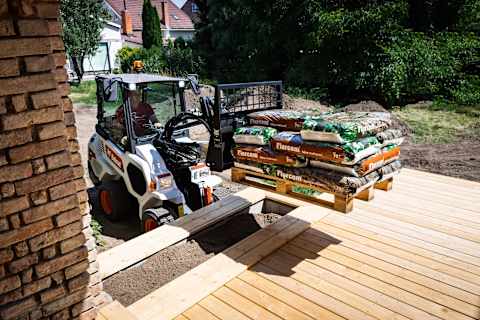
Older cattle barns, stables, and poultry houses were designed for wheelbarrows, not tractors. A small articulated loader steers by pivoting at a center joint rather than skidding its tires, allowing for tighter turns with minimal disruption to bedding or floor surfaces. The Bobcat L23 and L28 models feature four-wheel drive and a turf mode to limit ground disturbance. In narrow feed passages where a rigid machine would struggle, an articulated loader can often clear a corner in a single movement. The category is rooted in livestock: the first Bobcat loader was invented in the 1950s specifically to clean turkey barns.
Customer Experience
Highlighting the efficiency gains achieved by replacing manual routines with mechanized power, Mayor Alfredo Gaspar observed:
"There are obvious advantages when it comes to the most common tasks, and the end result always lives up to expectations. The Bobcat L28 loader has allowed us to mechanize manual work considerably, which makes a huge difference."
Will the machine actually fit your building?
- The loader must be measured with the attachment fitted — the bucket, not the chassis, is usually the widest part.
- The operator protection structure is a safety component, so roof height cannot be reduced to clear a low doorway.
Customer Experience
Confirming how compact articulated dimensions make maneuvering through tight, confined spaces manageable, Alfredo Gaspar, Mayor of Ontinar de Salz, noted:
"We are very satisfied with the performance of the Bobcat L28 articulated loader. It is the ideal model for our needs because of its compact dimensions, which are ideal for working in narrow streets, and it is very easy to operate."
A common mistake is relying on memory rather than a tape measure. Check the narrowest door, lowest beam, aisle width, and turning areas at both ends of a run. Many older barns have clearances of about two meters, which rules out taller machines. Mark the turning circle on the floor and request an on-farm demonstration with the actual machine and attachment before committing.
Where do the animals go while the loader is working?
Whenever possible, separate livestock from the machine to minimize stress and injury risk. Define an exclusion zone, plan your gate sequences, and keep the path to the trailer clear. Bobcat small articulated loaders help by providing an open operator area with 360-degree visibility, a seating position that keeps the operator facing the load, and standard backup alarms. While visibility is a major asset, it is no replacement for physical separation.
Can it work safely on wet floors and inside a closed building?
Wet manure, damp bedding, and polished concrete reduce grip and lengthen stopping distance — the cause of most loss-of-control incidents inside buildings. Tire choice is the main lever: the L23 and L28 are offered with turf, tractor, and standard duty options, plus automatic traction modes and an optional traction assist for slippery surfaces. Air quality is the second indoor factor. Both models are diesel powered, so plan open doors and ventilation, sequence the dustiest tasks, and keep indoor engine running time to what the job needs.
Will it lift your bales, feed, and muck?

Will it lift your bales, feed, and muck?
The number that matters is the one for your attachment in the position you actually work in. Capacity falls when the machine is articulated in a turn, falls again on forks, and falls further with a telescopic boom extended.
| Configuration | Tipping load L23 | Tipping load L28 |
|---|---|---|
| Straight, bucket | 1 265 kg | 1 392 kg |
| Articulated, bucket | 1 051 kg | 1 109 kg |
| Articulated, forks | 724 kg | 759 kg |
| Articulated, forks, boom extended | not available | 479 kg |
Both models use the Hybrid Bob-Tach™ mounting system, which accepts mini and standard Bob-Tach™ attachments and lets one operator swap between a bucket, farm grapple, pallet forks, or utility fork without leaving the seat. Counterweights are available where extra stability is needed. Weigh your heaviest bale, check it against the approved load information for the exact attachment, and stack on level ground with the machine straight.
Does your whole-farm workload justify buying one?
For a single repetitive manure route where animals cannot be moved, a fixed or automated system may be more efficient. A loader justifies its cost when it also handles feeding, bedding, bale transport, and yard maintenance. Ownership economics depend on annual utilization across multiple tasks, not just the cost of one specific job.
Customer Experience
Emphasizing how quick attachment changes allow a single carrier to handle diverse daily tasks, Mayor Alfredo Gaspar explained:
"It has given us a convenient way of working, as it is a highly versatile and multi-purpose machine, allowing us to perform different tasks with a quick change of attachments."
Both models are light enough to travel on a trailer behind a car, which extends their use to rented ground, and both are backed by a standard factory warranty. Before you sign, confirm:
- The machine and intended attachment have been driven inside your building, not just on the yard.
- Your heaviest routine load has been checked against the load chart for that attachment.
- Animal relocation and exclusion zones are written into the daily routine.
- Annual hours across all tasks support the investment.
- Your dealer can supply parts and service within the downtime your operation can absorb.
FAQ – Frequently Asked Questions
How wide does my barn door need to be for a small articulated loader?
Compare the door opening with the width over the bucket, not the machine width — the attachment is normally the widest point. Measure the narrowest point along the whole route, including gate posts and feed barriers.
Will the machine fit under a low beam?
Cab height on both models is 1 983.7 mm, which clears many older buildings but not all. The operator protection structure must not be removed or modified to gain clearance. If your lowest beam is close to that figure, ask for a demonstration before ordering.
Do the animals have to be moved before loader work?
Farm safety guidance treats separation of livestock from working machines as a basic requirement. Plan the relocation, agree on exclusion zones, and count that time as part of the job when comparing a loader with a fixed manure system.
Can a small articulated loader handle round bales?
It depends on bale mass, the attachment, and the working position — capacity drops when the machine is articulated and again on forks. Check your heaviest bale against the approved load information for the specific attachment and model, and handle bales on level ground with the machine straight.
Is it safe to run a diesel loader inside a livestock building?
Yes, provided exposure is controlled. Diesel engine exhaust emissions carry a binding EU workplace exposure limit, so ventilate the building, keep doors open, sequence dusty tasks, and limit indoor running time.
How do I know whether to buy a loader or a fixed manure system?
Map the full cycle for both, including animal relocation and the number of people needed. A fixed system usually wins on one repetitive route; a loader wins when feeding, bedding, bale handling, and yard work are added to the same machine.
Sources and Further Reading
- Bobcat L28 Small Articulated Loader
- Bobcat L23 Small Articulated Loader
- Bobcat Small Articulated Loaders
- Small Articulated Loaders for Agriculture
- Small Articulated Loader Attachments
- New Range of Small Articulated Loaders from Bobcat
- Bobcat L28 Articulated Loader, Mechanising Manual Work
- Bobcat Job Stories
Disclaimer
This content is provided for general informational and guidance purposes only. It may not reflect the specific requirements, conditions, configurations, attachments, applications, terrain, weather, or operating environment relevant to every machine or situation. Any models, configurations, availability, features, and specifications mentioned are provided for illustrative purposes only and may vary by market, region, dealer, and time. Operators, owners, and customers should always assess the actual working conditions and refer to the applicable operator’s manual, service manual, technical documentation, safety instructions, and product specifications for the specific Bobcat model and equipment being used. They should also consult an authorized Bobcat dealer or qualified professional before making operational, maintenance, purchasing, or safety-related decisions.