- Home
- Buyer's Guides
- Product Buyer's Guides
- Choosing the Right Mower: Ride-On, Walk-Behind, Stand-On, and Flail Explained
Choosing the Right Mower: Ride-On, Walk-Behind, Stand-On, and Flail Explained
Published on: 7 September 2026
In this article:
- Learn the differences between mower platforms (walk-behind, stand-on, and ride-on zero-turn) and cutting attachments like flail mowers.
- Discover the technical factors that matter most when matching a mower to a large lawn, estate, or sports turf site.
- Understand how to budget for total cost of ownership and build a pre-purchase checklist.
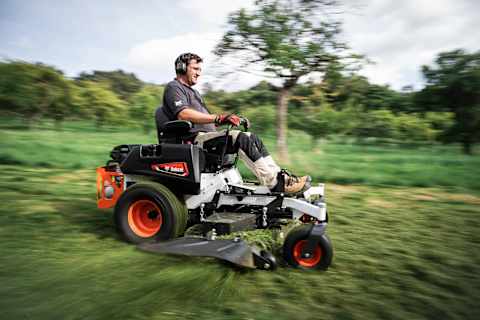
A large lawn, an estate, or a sports turf site rarely consists of just one type of ground. Open lawns, tight spaces around buildings, sloped banks, and overgrown edges often coexist on the same property. Buyers often compare walk-behind, stand-on, ride-on zero-turn, and flail mowers as if they were direct rivals for the same job. In reality, the decision comes down to two distinct needs: which operator platform best suits your maintained turf, and which attachment can handle the rougher ground.
Mower Platforms vs Cutting Implements
These machines fall into two categories, not one:
- Operator-platform mowers (walk-behind, stand-on, and ride-on zero-turn) carry the operator and a cutting deck built for a clean, presentation-quality finish on maintained turf.
- Cutting attachments such as a flail mower are mounted on a mini excavator, a compact loader, or a compact tractor, and are built to shred rough, woody, or overgrown vegetation rather than finish a lawn.
Bobcat's ground maintenance range mirrors this split: a zero-turn mower lineup covering walk-behind, stand-on, and ride-on platforms for turf, and self-leveling flail mower attachments built separately for mini excavators and compact loaders.
| Platform | Operator position | Maneuverability around obstacles | Best suited to |
|---|---|---|---|
| Walk-behind mower | Walking behind the deck | High, narrow footprint for gates and borders | Tight access, limited trailer space |
| Stand-on mower | Standing, fast on/off | High, compact chassis with quick access | Multi-site routes, frequent stops |
| Ride-on zero-turn mower | Seated, suspension seat on larger models | High close to obstacles, wider for gates | Large open areas, sustained productivity |
| Compact tractor with mower attachment | Seated, ROPS-protected | Moderate, wider turning circle | Towing or attachments beyond mowing |
| Flail mower attachment (mini excavator or compact loader) | Seated in the carrier, cutting head remote | Very high, extended by the carrier's reach | Rough, woody, or hard-to-reach vegetation |
Separating platform from attachment answers a common question on its own: a flail generally cannot replace a finishing mower, because the two solve different mowing problems.
Identify What Your Site Actually Needs
- What proportion of the site is open turf versus tight access around obstacles, buildings, or borders?
- Does the ground include slopes, wet zones, or rough growth a finishing deck cannot manage?
- How many hours will the machine run each season, enough to justify a commercial-grade platform?
- Does the site also need towing, grading, or snow clearance beyond mowing?
- How will the mower be transported between zones, and what does that mean for trailer space?
Bobcat dealers work through this same profile before recommending a walk-behind, stand-on, ride-on zero-turn, compact tractor, or flail-equipped machine, rather than defaulting to the largest deck available.
Key Technical Factors to Compare
- Cutting deck width: a wider deck cuts more ground per pass on large lawns; a narrower deck keeps access through gates and between obstacles. Bobcat's zero-turn mowers offer a choice of deck widths for this reason.
- Drive system: hydrostatic transaxles, fitted across Bobcat's zero-turn and walk-behind mowers, deliver smooth, high-torque power that holds cutting speed steady on rougher ground.
- Ground clearance and stability: a low center of gravity, engineered into stand-on platforms such as the Bobcat ZS4000 zero-turn stand-on mower, improves stability around obstacles and on undulating turf. The ZS4000's platform can also flip up into a walk-behind configuration for tight or sensitive zones.
- Operator position: walking increases physical demand over a shift; standing improves visibility and speeds up dismounting; sitting on a suspension seat, fitted to larger ride-on models such as the Bobcat ZT3500 zero-turn mower, reduces vibration on rough ground.
Attachments and Where Flail Mowers Fit

Attachments and Where Flail Mowers Fit
- For maintained turf: mulching kits, grass collection systems, and a choice of cutting decks extend a zero-turn or walk-behind mower.
- For rough or hard-to-reach ground: a flail mower attachment, mounted on a mini excavator or compact loader, takes on branches, thick grass, bushes, or small trees along ditches, banks, fences, or corners a turf mower cannot reach. Bobcat's self-leveling flail mowers use rollers to follow ground contours and a drum braking circuit that stops the cutting rotor within seconds of being lifted, with guards fitted to divert debris.
- For multi-purpose sites: a mid-mount mower or finishing mower attachment adds turf mowing to a compact tractor already used for towing, grading, or snow clearance.
A flail mower processes rough growth that would clog a finishing deck, but it will not deliver the same presentation-quality cut. Most estates and sports facilities need both.
Budgeting for Total Cost of Ownership
- Beyond the sticker price: fuel or engine hours, routine service access, and parts availability all build up across a season.
- Build quality: durable, tubed steel framing and easy-access service points, standard across Bobcat's zero-turn and walk-behind mowers, are designed to limit wear and keep routine maintenance quick.
- Fleet size: running two mid-sized machines matched to different ground types can cost less than one oversized mower.
- Buy versus lease: compare against a realistic estimate of annual working hours before choosing a machine, not after.
Pre-Contract Checklist
- Confirm which cutting decks, mulching kits, and safety equipment, such as a ROPS kit, are available for the model under consideration.
- Check that the mower meets the applicable EU garden equipment safety standard for its category, whether ride-on, walk-behind, or stand-on.
- Ask about dealer proximity, standard warranty terms, and parts lead times before signing.
- Confirm cutting deck width and transport dimensions against trailer and gate widths on site.
- Request a demonstration on the actual site, including any slopes or rough sections, not just a showroom test.
Matching the Mower to the Site, Not Ranking It
No platform is universally the safest or most productive choice. Model design, ground condition, moisture, and operator technique all change the outcome. For many estates, sports facilities, and grounds teams, that means running more than one machine rather than searching for a single mower that does everything.
FAQ – Frequently Asked Questions
Is a walk-behind mower safer than a ride-on zero-turn mower on slopes?
Neither is automatically safer. Stability depends on the specific machine's design, tire grip, ground moisture, and operator technique, so follow the manufacturer's slope guidance for that model.
Can a flail mower replace my finishing mower?
Not directly. A flail mower shreds rough, woody, or overgrown vegetation; a finishing mower on a zero-turn or compact tractor platform delivers a clean, presentation-quality cut. Most estates need access to both.
What is the advantage of a stand-on mower?
It combines a compact footprint with fast dismounting for opening gates or clearing debris. Some models, such as the Bobcat ZS4000, can also flip the platform up to work as a walk-behind for tight areas.
Do I need a compact tractor if I already have a zero-turn mower?
Only if the site needs more than mowing. A compact tractor fitted with a mid-mount or finishing mower adds towing, grading, or snow clearance that a dedicated zero-turn mower cannot offer.
How much does operator fatigue matter when choosing a platform?
On long days, operator position affects productivity as much as ground speed. Walking, standing, and sitting each trade off fatigue against visibility and control, so test on the actual site.
Will a zero-turn mower damage soft or maintained turf when it pivots?
Turf scuffing is usually caused by stationary pivots, worn tires, or mowing on saturated ground rather than the platform itself. Rolling turns and well-maintained tires reduce the risk.
What attachments should I check before buying a mower?
Confirm which cutting deck widths, mulching kits, and safety equipment are available for the platform, and whether flail mower attachments are compatible with any mini excavator or compact loader already in the fleet.
Sources and Further Reading
- Bobcat Mowers
- Bobcat ZT3500 Zero-Turn Mower
- Bobcat WB700 Zero-Turn Walk-Behind Mower
- Bobcat ZS4000 Zero-Turn Stand-On Mower
- Bobcat Launches New Line of Mowers for Professional Use
- Bobcat Flail Mower, Self-Levelling
- New Self-Levelling Flail Mowers for Bobcat Excavators
- Bobcat Mid-Mount Mower
- Bobcat Compact Tractor Attachments
Disclaimer
This content is provided for general informational and guidance purposes only. It may not reflect the specific requirements, conditions, configurations, attachments, applications, terrain, weather, or operating environment relevant to every machine or situation. Any models, configurations, availability, features, and specifications mentioned are provided for illustrative purposes only and may vary by market, region, dealer, and time. Operators, owners, and customers should always assess the actual working conditions and refer to the applicable operator’s manual, service manual, technical documentation, safety instructions, and product specifications for the specific Bobcat model and equipment being used. They should also consult an authorized Bobcat dealer or qualified professional before making operational, maintenance, purchasing, or safety-related decisions.