- Home
- Buyer's Guides
- Product Buyer's Guides
- Choosing the Right Turf Renovation Equipment: A Buyer's Guide
Choosing the Right Turf Renovation Equipment: A Buyer's Guide
Published on: 14 September 2026
In this article:
- How to tell whether your turf needs light maintenance or a full renovation before buying equipment.
- How sod cutters, aerators, and dethatchers each solve a different turf renovation problem.
- How to build an equipment plan around your budget, timing, and reopening date.
Soil compaction, thatch build-up, worn patches, and a failed rootzone can all look the same from a distance, but they each require a different set of tools. Buying the wrong piece of equipment is a quick way to waste your budget and miss the narrow window you have before your site needs to reopen. This guide helps you diagnose the issue first, then matches your needs to the right Bobcat sod cutter, aerator, or dethatcher.
Decide what your turf actually needs before you choose a machine

Decide what your turf actually needs before you choose a machine
Before you commit to a machine, check these three things:
- Surface levels and drainage, to rule out a rebuilding-level problem before treating it as routine maintenance.
- Compaction depth and thatch thickness, since these determine how aggressive the cultivation needs to be.
- Root condition and turf density, which show whether existing grass is worth building on at all.
Each equipment category is designed to solve a specific part of that diagnosis.
Removing old or damaged turf: choosing the right sod cutter
When a surface is contaminated with weeds, badly rutted, or simply beyond the point where cultivation can save it, the turf needs to come out so you can start fresh. A sod cutter slices beneath the existing turf at a controlled depth, lifting it in uniform strips so you can relevel or resurface the area without leaving torn, uneven ground behind. The Bobcat sod cutter range covers three working widths and two drive types:
| Model | Working width | Best suited for |
|---|---|---|
| Bobcat SC12 | 305 mm | Smaller or intricate areas, garden beds, narrow access points |
| Bobcat SC18 | 457 mm | Larger lawns and sports areas requiring faster coverage |
| Bobcat SC18H | 457 mm | Uneven or sloped ground where finer speed control matters |
The SC18H includes a hydrostatic transmission for better control on difficult or sloping terrain. It’s always best to match the working width to your specific site so you aren’t paying for extra capacity you don’t actually need.
Relieving compaction and reviving root growth: choosing an aerator
Relieving compaction and reviving root growth: choosing an aerator
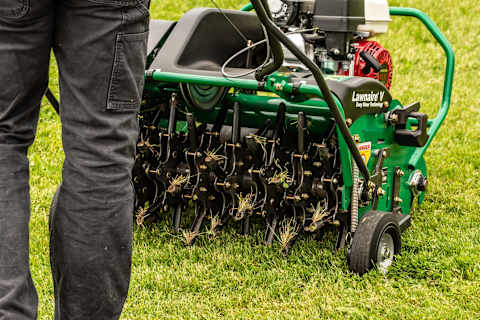
Compacted soil prevents air, water, and nutrients from reaching the root zone. Seeding or feeding won’t help much until you address the compaction itself. Aeration drives tines into the soil to open up channels for air and water exchange, which encourages deeper, healthier root growth. Bobcat offers two working widths:
- The Bobcat AE19 aerator has a 483 mm working width and Easy Steer Technology, which allows an operator to maneuver around obstacles without lifting the tines. This makes it a great choice for residential lawns and tighter landscaped areas.
- The Bobcat AE26 aerator steps up to a 673 mm width for higher-output aeration across larger lawns and sports facilities, using the same cast-iron tine wheel design for consistent penetration in harder ground.
Hollow-tine coring is more disruptive than solid or needle tining, so be sure to match the tine type and machine size to the recovery time your site can handle.
Clearing thatch and preparing the seedbed: dethatchers and the overseeder
A thick layer of thatch blocks seed, water, and fertilizer from reaching the root zone. Overseeding into thatch usually fails, no matter how high-quality your seed is. Bobcat dethatchers use adjustable cutting depth controls to remove thatch without pulling up healthy grass, allowing you to match the intensity to your actual needs. The range runs from light renovation to full seedbed preparation:
- The Bobcat DT18 dethatcher is a self-propelled, walk-behind machine with a 457 mm working width, perfectly suited for lighter renovation work on lawns and smaller areas.
- The Bobcat DT19 dethatcher steps up to 483 mm width for heavy-duty dethatching and verticutting on sports turf and larger commercial sites.
- The Bobcat DT20 dethatcher-overseeder places seed directly into the prepared surface, improving seed-to-soil contact compared with broadcasting seed onto an untreated lawn.
Choosing between a standard dethatcher and a dethatcher-overseeder really comes down to whether your job ends with thatch removal or includes establishing new turf.
Building your equipment plan around budget, timing, and the reopening date
Aggressive cultivation improves soil health, but it also means the surface will be out of commission for a while. Zoned renovation—focusing on high-traffic areas like goalmouths, center circles, or walk-off zones first—is a great way to manage a tight budget and recovery window without closing an entire field at once. Before you order your equipment, run through this checklist:
- Confirm the diagnosis and the specific layer being targeted, whether that is the turf itself, soil compaction, or a thatch layer.
- Match the equipment category to that diagnosis rather than to habit or what was used last time.
- Check the working width against your site's typical access points, gates, and trailers.
- Decide whether rental or ownership makes more sense for occasional jobs.
- Agree a realistic recovery window with whoever manages the reopening date before work starts.
FAQ – Frequently Asked Questions
How do I know whether I need a sod cutter, an aerator, or a dethatcher?
You should match the equipment to the specific problem you’re facing. If the turf is worn or contaminated and needs to be removed entirely, you need a sod cutter. If the soil is compacted and restricting root growth, an aerator is the right tool. If there’s a layer of thatch blocking seed and water, you’ll want a dethatcher.
What is the difference between the Bobcat AE19 and AE26 aerators?
The AE19 has a 483 mm working width and suits smaller, residential-scale lawns, while the AE26 widens to 673 mm for faster, deeper aeration on larger lawns and sports facilities. Both use the same cast-iron tine wheel design for consistent penetration.
Do I need the DT20 dethatcher-overseeder, or is a dethatcher enough?
A dethatcher is perfect for removing thatch and preparing the surface if you aren’t planning to plant new seed immediately. The DT20 dethatcher-overseeder is designed for jobs that include establishing new turf, as it places seed directly into the prepared ground for much better seed-to-soil contact.
How wide a sod cutter do I actually need?
It’s best to base your choice on the site’s layout rather than just the size of the job. The 305 mm SC12 is ideal for smaller or more intricate areas like garden beds, while the wider SC18 and SC18H models cover larger lawns and sports fields much faster. The SC18H also features a hydrostatic transmission, which gives you finer control on uneven ground.
Can I renovate only part of a surface instead of the whole area?
Absolutely. Zoned renovation—prioritizing high-wear areas like goalmouths, center circles, or walk-off zones—is a practical way to stay within a limited budget or a tight recovery window while still making a noticeable improvement.
How should I plan the recovery window before I buy equipment?
There’s no single number of days that works for every turf species, climate, or method. We recommend agreeing on a realistic recovery window with your facility manager before work begins, then choosing your tine type, cutting depth, and timing based on that plan.
Sources and Further Reading
Disclaimer
This content is provided for general informational and guidance purposes only. It may not reflect the specific requirements, conditions, configurations, attachments, applications, terrain, weather, or operating environment relevant to every machine or situation. Any models, configurations, availability, features, and specifications mentioned are provided for illustrative purposes only and may vary by market, region, dealer, and time. Operators, owners, and customers should always assess the actual working conditions and refer to the applicable operator’s manual, service manual, technical documentation, safety instructions, and product specifications for the specific Bobcat model and equipment being used. They should also consult an authorized Bobcat dealer or qualified professional before making operational, maintenance, purchasing, or safety-related decisions.