- Home
- Buyer's Guides
- Product Buyer's Guides
- How to Size Turf Renovation Equipment: A Buyer's Guide to Bobcat Aerators, Sod Cutters, and Dethatchers
How to Size Turf Renovation Equipment: A Buyer's Guide to Bobcat Aerators, Sod Cutters, and Dethatchers
Published on: 18 September 2026
In this article:
- Match the job to the right Bobcat equipment category before comparing specifications.
- Check operating width, weight, and power against your specific site conditions, not just against each other.
- Use a machine’s maximum working depth as a capability limit—then dial in the setting that suits your soil and turf.
Choosing the right turf renovation equipment starts with a careful look at your site. Access points, turf sensitivity, soil condition, and expected daily output all help determine which model is the right fit. This guide covers how to size Bobcat aerators, sod cutters, dethatchers, and the dethatcher-overseeder for your job.
Start with the job

Start with the job
Turf renovation covers several distinct tasks, each requiring a different machine. Bobcat’s European turf renovation lineup features four dedicated categories:
- Aerator: Relieves soil compaction, allowing air, water, and nutrients to reach the root zone.
- Dethatcher: Removes the layer of dead grass and organic debris between the soil and the living turf.
- Sod cutter: Lifts and removes existing turf, typically before replacement or renovation work.
- Dethatcher-overseeder: Removes thatch and introduces new seed into existing turf in a single pass, thickening growth and filling patchy areas.
Identifying which of these jobs you need to solve first narrows your search to the relevant models before width, weight, or power enter the discussion.
How wide should your machine be?
Operating width determines how many passes you need to complete an area—and whether the machine can navigate every part of the site. Before comparing models, verify:
- The narrowest access point the machine must pass through, such as gates, side passages, or fence gaps.
- The turning space available at the ends of each pass.
- Fixed obstacles on the lawn, including trees, edging, or irrigation heads.
The Bobcat aerator range spans from compact, walk-behind models for smaller or obstructed residential lawns to wider units for large, open areas. The dethatcher range follows a similar pattern. The specifications table below lists operating widths across the full lineup so you can match each model to your access constraints.
How much power does the job require?
Engine power determines whether a machine can maintain consistent tine or reel engagement with the ground. Dense, compacted soil or heavy thatch requires more sustained driving force than a well-maintained, lighter lawn. Use these guidelines to match the power tier to your situation:
- Light, regularly maintained turf: Use a lower power tier, as it will be used less frequently.
- Dense, compacted, or thickly thatched turf: Choose a higher power tier for consistent engagement.
- Commercial or high-frequency use: Select a higher power tier, sized for duty cycle rather than a single job.
The Bobcat dethatcher range illustrates this: the DT18 suits regular turf renovation and verticutting on typical residential lawns, while the DT19 is built for heavier-duty, higher-frequency commercial work. The dethatcher-overseeder (DT20) also features a higher power tier, which supports the combined demands of thatch removal and seeding.
Will the machine protect or mark your turf?
Weight helps a machine penetrate compacted or dry ground, but it becomes a liability on soft, moist, or ornamental turf. Heavier machines can cause wheel-track marking and rutting, especially when turning. The right weight class depends on your site:
- Ornamental, newly established, or sensitive turf: Choose a lighter model with lower ground pressure.
- Frequently damp or soft ground: Lighter models reduce the risk of surface damage.
- Tight turning space: Ground pressure concentrates at the pivot point, where marking is most visible.
Bobcat’s sod cutter and aerator ranges include lighter models suited to sensitive turf alongside heavier, more robust models for tougher commercial ground. Matching the weight class to your turf’s tolerance keeps a renovation job from becoming a repair project.
Is maximum working depth the depth you should use?
Is maximum working depth the depth you should use?
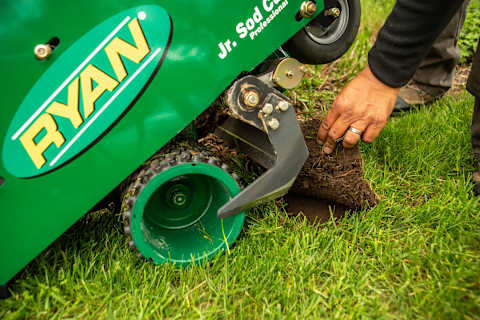
A machine’s stated maximum operating depth describes its capability under ideal conditions—not a recommended default setting. Soil moisture, compaction, thatch thickness, and stone content all affect how deep you should run the machine on any given job. Before setting depth:
- Identify the target layer, whether it is a thatch band, a compaction zone, or a specific seed placement depth.
- Assess current soil moisture, as dry or waterlogged ground changes how the machine performs.
- Run a test pass on a small, representative area before committing to the full site.
Bobcat dethatchers include adjustable cutting depth controls so the same machine can be run conservatively on harder or drier ground and adjusted further when conditions allow.
Reading the specifications
The table below outlines the current Bobcat European turf renovation lineup. It provides the figures you need to compare models within each category—operating width, engine power, and weight—so you can cross-check each against your site’s access, turf sensitivity, and expected workload.
| Category | Model | Operating width | Engine power | Weight (with included weights) |
|---|---|---|---|---|
| Aerator | AE19 | 483 mm | 2.4 kW | 138 kg |
| Aerator | AE26 | 673 mm | 2.4 kW | 162 kg |
| Sod cutter | SC12 | 305 mm | 3.6 kW | 151 kg |
| Sod cutter | SC18 | 457 mm | 3.6 kW | 169 kg |
| Sod cutter | SC18H | 457 mm | 3.6 kW | 172 kg |
| Dethatcher | DT18 | 457 mm | 3.6 kW | 60 kg |
| Dethatcher | DT19 | 483 mm | 8.7 kW | 171 kg |
| Dethatcher-overseeder | DT20 | 483 mm | 8.7 kW | 205 kg |
For a quick check against your site before shortlisting:
- Confirm the operating width fits the narrowest access point and available turning space.
- Confirm the weight class suits how sensitive the turf is to marking.
- Confirm the power tier matches the density of the turf and your expected frequency of use.
One practical note on capacity: multiply the operating width by travel speed to get a theoretical output figure. Then, reduce that figure to account for overlap between passes, turning time at the end of runs, and time spent refilling or emptying the machine. The actual output will be noticeably lower than the theoretical number—planning for this realistic figure avoids scheduling headaches on the day of the job.
Disclaimer
This content is provided for general informational and guidance purposes only. It may not reflect the specific requirements, conditions, configurations, attachments, applications, terrain, weather, or operating environment relevant to every machine or situation. Any models, configurations, availability, features, and specifications mentioned are provided for illustrative purposes only and may vary by market, region, dealer, and time. Operators, owners, and customers should always assess the actual working conditions and refer to the applicable operator’s manual, service manual, technical documentation, safety instructions, and product specifications for the specific Bobcat model and equipment being used. They should also consult an authorized Bobcat dealer or qualified professional before making operational, maintenance, purchasing, or safety-related decisions.