- Home
- Buyer's Guides
- Product Buyer's Guides
- Mini Track Loaders for Landscaping and Lawn Projects: How to Decide If One Fits Your Work
Mini Track Loaders for Landscaping and Lawn Projects: How to Decide If One Fits Your Work
Published on: 1 September 2026
In this article:
- You will learn how to match a mini track loader to the landscaping tasks your crew repeats most often.
- You will discover why rubber tracks improve flotation on turf yet can still tear an established lawn during skid turns.
- You will understand how access, transport weight, attachments, and annual utilization decide whether buying, renting, or subcontracting is the better call.
Landscapers look at a mini track loader for one reason above all others: the machine passes through a garden gate and still moves far more material in a day than a crew working by hand. That combination of narrow access and mechanized carrying capacity is what makes the category interesting for lawn renovation, planting, hard landscaping, and tree work. It is also where the questions start. Will the tracks damage the lawn you were hired to improve? Will a light carrier dig compacted clay? Will the loader earn its keep across a full season? This guide works through those decisions in the order a buyer faces them.
What landscaping work is a mini track loader built for?
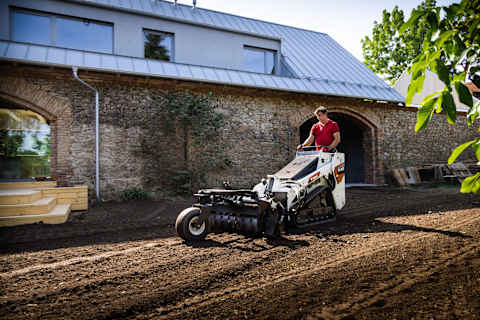
What landscaping work is a mini track loader built for?
Most disappointment with a mini track loader comes from buying the machine before defining the job. Repetitive material movement is where it is strongest, including topsoil, bark, gravel, turf rolls, paving, and green waste carried between a delivery point and a working area. Soil preparation, planting, fencing, irrigation, and tree work follow closely because each combines carrying with a powered tool.
The Bobcat MT100 and MT120 mini track loaders are ride-on machines designed around short repetitive cycles in confined ground. Both models use the Bob-Tach™ mounting system, and the MT120 supports more than twenty attachment categories, turning one carrier into a machine for several recurring services. In daily terms, the loader replaces barrow runs, not the digger.
Will a mini track loader damage the lawn?
The honest answer has two halves. Rubber tracks spread machine weight over a larger contact area than tyres, which reduces sinking and rutting on soft ground. Ground pressure alone does not protect turf, though. Damage on grass is caused mainly by shear, which happens when a skid-steered machine pivots on the spot and the track scuffs the surface sideways.
- Straight travel on dry, firm turf produces far less damage than repeated passes along the same route.
- Wide, sweeping turns instead of counter-rotating pivots are the most effective operator technique for protecting an established lawn.
Wet ground multiplies the risk because saturated soil shears easily and compacts under load. Track width matters too. The MT100 offers narrow tracks or a wider option that lowers ground pressure, and the MT120 offers a narrow track for tight access or a wider track for stability. Track condition matters as much as track width. Bobcat supplies genuine rubber tracks in matched tread patterns and quality grades, so a replacement set behaves on turf the way the original did. Planning the route, matching track width to the surface, and turning wide protect the finished job and avoid remedial returfing at your own cost.
“An essential advantage of the Bobcat MT100 is its compact size. Narrow paths and spaces around and inside buildings can be accessed easily. Another advantage is the tracks, which allow us to get anywhere,” says Kamil, an operator at the Polish company Skomar, summarizing the benefits of their new MT100.
How do you check the machine fits the whole access route?
Buyers often measure the gate and stop there. A machine that clears the entrance can still be unusable in the rear garden, so measure the whole working envelope first.
| What to measure | Why it matters |
|---|---|
| Narrowest gate or side passage | Machine width with tracks fitted must clear it |
| Attachment width | Buckets and soil tools are wider than the carrier |
| Overhead clearance | Porches, pergolas, and branches limit the platform and lift arms |
| Turning area at the working end | A machine that enters but cannot turn cannot work |
| Unloading and tipping space | Lift height and reach decide whether you can load on site |
| Ground surface on the route | Steps and drainage covers restrict the approach |
The MT100 and MT120 are both built around a narrow standard track width for this reason, with a wider option where stability matters more than access. Walking the route with a tape measure before quoting protects you from arriving with a machine that stays on the trailer.
Can a mini track loader dig hard or compacted soil?
Expect a light carrier to move material well and to excavate only within limits. Digging performance depends on carrier mass, breakout force, the attachment fitted, and soil moisture. A smooth-edged bucket on dry, compacted clay skids across the surface rather than penetrating it. A toothed bucket, a tiller, or a soil conditioner changes the result, as does working ground that holds some moisture.
The distinction that saves money is between excavation and soil preparation. If the job is a trench, a footing, or a pond, a Bobcat mini excavator is the correct carrier. If the job is breaking up, levelling, and preparing a seedbed, the Bobcat soil conditioner attachment is designed to grade topsoil, pulverise clumps, tear out old sod, and windrow stones. Matching the tool to the soil task avoids the frustration of a machine that appears underpowered when it is simply mismatched.
Which attachments actually earn their place?

Which attachments actually earn their place?
Attachment spend decides whether a mini track loader becomes profitable or remains an expensive carrier for a single bucket. An attachment justifies itself when it serves work you sell repeatedly, not a job you take once a year.
| Recurring service | Attachment to prioritise | Manual work replaced |
|---|---|---|
| Topsoil, gravel, and bark handling | General purpose bucket | Barrow runs and shovelling |
| Seedbed and lawn renovation | Soil conditioner or tiller | Raking and hand cultivation |
| Fencing and planting | Auger | Manual post-hole digging |
| Irrigation and cable runs | Trencher | Hand trenching |
| Tree work and green waste | Grapple | Manual loading of brash |
| Site clearance and levelling | Dozer blade | Hand levelling |
Two checks decide whether the attachment performs as advertised. Auxiliary hydraulic flow must meet the tool's requirement, and the combined weight of attachment and load must stay within the carrier's rated operating capacity and tipping load. Bobcat states that its carriers and attachments are matched and tested together, so compatibility should be confirmed per model rather than assumed from a common interface.
“In our company, we use a bit of everything. At this site, we mainly use an angle broom to clean the roadside. The tiller is usually used to scarify humus soil around buildings, the bucket perfectly disperses humus brought by trucks and delivers it to paths where needed, and forks are mainly used to unload pallets,” summarizes Kamil from Skomar regarding the versatility of the machine's attachments.
Is ride-on operation comfortable enough for a full day?
Operator format is treated as a comfort question, but it is really a productivity question. A platform machine is quick to mount and dismount, which suits landscaping work where the operator is also rigging, planting, and finishing by hand. Visibility to the attachment and the ground around the tracks is good, which matters on domestic sites with fixed features close by.
The limitation is exposure. A platform gives no enclosure from rain, wind, dust, or debris, so a full winter day is a different proposition from an hour of loading. The MT120 uses pilot controls for precise work on delicate surfaces and an integrated platform built around all-round visibility, and the MT100 uses ergonomic ISO joystick controls with neutral-start interlocks and lift arm lockouts. A domestic garden is harder to work safely than a fenced site, because clients, children, and pets wander in without warning. Plan the route, keep people clear of the machine, wear high-visibility clothing, and walk round it each morning.
Can you transport it alongside the rest of your kit?
Transport is where small landscape crews most often discover a problem after purchase. The calculation is not machine weight alone. It covers the machine, every attachment traveling with it, the trailer, and any second machine, measured against the towing vehicle and the driver's license.
| Model | Operating weight | Rated operating capacity | Standard track width |
|---|---|---|---|
| Bobcat MT100 | 1 538 kg | 460 kg | 904 mm |
| Bobcat MT120 | 1 687 kg | 544 kg | 904 mm |
Across the EU, a standard category B license covers a combination up to 3,500 kg maximum authorized mass, with category B96 extending that to 4,250 kg and category BE going further again. A loader plus attachments plus a plant trailer approaches that threshold quickly, so confirm the entitlement before ordering. The MT120 includes built-in tie-down points and designated lifting locations, which speeds up loading and reduces the risk of an insecure load.
Should you buy, rent, or subcontract?
Utilization decides this, not enthusiasm. A mini track loader working two days a week is a different financial case from one that comes out for four jobs a year.
- Ownership makes sense when the loader supports several recurring services, replaces measurable labor hours, and can be charged to clients as part of a quoted rate.
- Rental makes sense for seasonal peaks, one-off projects, and testing whether the machine changes how your crew works before capital is committed.
Bobcat offers rental through its dealer network with servicing handled by the dealer, which removes both the storage and the workshop burden from a small business. For owners, the BobCARE planned maintenance program provides scheduled servicing with genuine parts and documented history, which supports uptime during the season and resale value afterward. One further EU point favors this machine class: engines below 19 kW are not required to carry a diesel particulate filter under Stage V rules, and the MT120 is specified with a filter-free engine, which removes one maintenance variable from the ownership calculation.
FAQ – Frequently Asked Questions
Will a mini track loader leave marks on an established lawn?
It can, and low ground pressure does not prevent it on its own. Damage comes mainly from shear during skid turns, from wet ground, and from repeated passes on the same route. Straight travel on dry, firm turf with wide, sweeping turns produces the best result.
How do I know the machine will fit the site before I quote?
Measure the narrowest gate or passage, the attachment width, overhead clearance, the turning area at the working end, and the space available for unloading. The carrier width in the brochure is only one of those numbers.
Can a mini track loader replace a mini excavator?
Not for excavation. Trenches, footings, and deeper digs belong to a mini excavator. A mini track loader is a carrying and surface-preparation machine that can dig within limits when the right attachment and soil conditions come together.
Which attachment should a landscaping business buy first?
Start with the tool that serves your most frequently sold service. For most landscape crews, that is a bucket for material handling, followed by a soil conditioner for lawn renovation or an auger for planting and fencing.
Is a ride-on platform suitable for working all day?
It suits work where the operator moves on and off the machine frequently. The trade-off is exposure to weather, dust, and debris, so plan for appropriate clothing and eye protection on long or wet days.
Do I need a special license to tow one?
Check the combined weight of the towing vehicle, trailer, machine, and attachments against your entitlement. A standard category B license covers combinations up to 3,500 kg maximum authorized mass, and heavier combinations require B96 or BE.
Is it cheaper to rent or to own?
It depends on annual utilization. A loader that supports several chargeable services across the season builds a case for ownership, while seasonal or occasional work is usually better served by rental from a dealer.
Sources and Further Reading
- Bobcat Mini Track Loaders
- Bobcat MT100 Mini Track Loader
- Bobcat MT120 Mini Track Loader
- Bobcat Launches New MT100 Mini Track Loader
- Bobcat Launches Its Most Powerful Mini Track Loader, the MT120
- Bobcat Soil Conditioner
- Bobcat Trencher
- Bobcat Landscaping Attachments
- Creating the Best Match of Carriers and Attachments
- Bobcat Rental
- BobCARE Planned Maintenance
- Bobcat Tracks
- Bobcat MT100 Customer Testimonial
Disclaimer
This content is provided for general informational and guidance purposes only. It may not reflect the specific requirements, conditions, configurations, attachments, applications, terrain, weather, or operating environment relevant to every machine or situation. Any models, configurations, availability, features, and specifications mentioned are provided for illustrative purposes only and may vary by market, region, dealer, and time. Operators, owners, and customers should always assess the actual working conditions and refer to the applicable operator’s manual, service manual, technical documentation, safety instructions, and product specifications for the specific Bobcat model and equipment being used. They should also consult an authorized Bobcat dealer or qualified professional before making operational, maintenance, purchasing, or safety-related decisions.