- Home
- Buyer's Guides
- Product Buyer's Guides
- Small Articulated Loaders for Stable, Yard, Park, and Turf Cleanup: A Buyer's Guide
Small Articulated Loaders for Stable, Yard, Park, and Turf Cleanup: A Buyer's Guide
Published on: 27 August 2026
In this article:
- Map the complete cleanup cycle, from material source to disposal point, before you choose a machine.
- Bedding, manure, branches, and fine surface debris each require a different attachment, because no single tool covers all four.
- The ownership case rests on how often the machine works, and a short pre-contract checklist covers the rest.
Mucking out a stable, sweeping a yard, clearing a parking lot, or cleaning up a park after a storm are recurring jobs that eat up hours of manual labor. A small articulated loader can absorb much of that work, but only when the machine, the attachment, and your site's layout fit together.
What is a small articulated loader, and when does it beat a bigger machine?

What is a small articulated loader, and when does it beat a bigger machine?
Yard and stable operators usually weigh three options: a compact wheel loader, a compact tractor with a front loader, or a small articulated loader. A heavier wheel loader offers more value per metric ton of lift but often struggles to enter narrow passages between feed racks or cannot drive onto a manure store with a limited point-load rating. A small articulated loader solves that access problem with a center pivot joint that lets the machine turn inside an aisle rather than shuffling back and forth. Bobcat builds two models in this class, the L23 and the L28.
| Specification | L23 | L28 |
|---|---|---|
| Tipping load | 1,051 kg | 1,109 kg |
| Operating weight | 1,719 kg | 1,903 kg |
| Engine power | 18.2 kW | 18.2 kW |
| Typical fit | Tightest access, lower transport weight | Higher reach and dumping height |
Customer Experience
Confirming the operational advantage of compact dimensions when navigating restricted access routes and tight spaces, Alfredo Gaspar, Mayor of Ontinar de Salz, noted:
"We are very satisfied with the performance of the Bobcat L28 articulated loader. It is the ideal model for our needs because of its compact dimensions, which are ideal for working in narrow streets, and it is very easy to operate."
A small articulated loader can reach working areas a larger loader cannot, and it is light enough to travel between sites on a trailer behind a standard vehicle.
How do you map the cleanup cycle before choosing a machine?
Bucket capacity is rarely the limiting factor for your cleanup cycle—your route is. Before you shortlist machines, measure door openings, aisle widths, overhead clearance, and the turning area at the end of the run, then test on-site with the actual material you move. Account for the tipping height you need at the trailer, hopper, or muck heap; a machine that cannot clear the sideboard forces a second handling step every cycle. The Bobcat L28 small articulated loader addresses this with an extendable boom and a lift height that clears trenches and pavements.
Which attachment matches the material you are moving?
Stable and grounds maintenance produce materials that behave differently, so a single attachment cannot collect all of them cleanly. Loose bedding and manure need retention, branches need a grip, and fine grit needs containment rather than pushing. Bobcat small articulated loaders use a hybrid Bob-Tach™ mounting system that accepts both mini and standard Bob-Tach™ attachments, and the operator engages the wedges from a switch in the cab without stepping down.
Customer Experience
Demonstrating how equipping a loader with a tailored multi-attachment package maximizes productivity across grounds cleanup, Mayor Alfredo Gaspar explained:
"To get the most out of the machine, we’ve also purchased a series of attachments such as a brush cutter, a hammer, a sweeper, and pallet forks, which are very useful when it comes to maintaining and developing green spaces."
- A general-purpose or utility bucket handles loose bulk material such as sand, gravel, soil, and scraped bedding.
- A farm grapple retains loose hay, bedding, and manure that would otherwise spill off a plain bucket.
- A root grapple or industrial grapple holds branches, brush, and awkward waste that a bucket cannot contain.
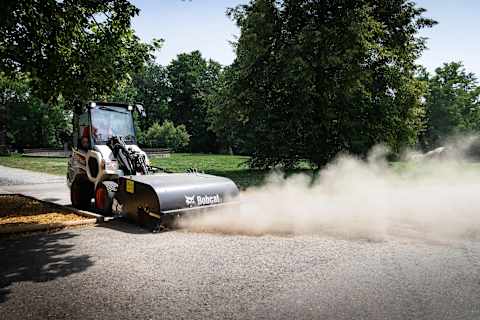
- A sweeper collects fine dirt and debris into a hopper, containing the material rather than pushing it around.
- An angle broom clears thin surface debris, dried mud, and light snow from paving and hard surfaces.
Two or three tools that match your dominant materials beat a long list of attachments you rarely use.
How do you protect turf, paving, and wet indoor floors?
Articulated steering reduces the scrubbing that skid-steer machines cause on grass, but it doesn't make a loader harmless on soft ground. Repeated passes along the same line, wheel slip under load, and turns on wet turf can still leave marks. Wet concrete, compacted manure, gravel, and lawn each reward a different tire choice and travel speed, so avoid fitting turf tires to a machine that occasionally needs heavy traction. Bobcat small articulated loaders are designed for low ground disturbance and include a dedicated turf mode for fragile surfaces. Treat turf mode as a way to widen your working window, not as a license to ignore conditions.
How do you control visibility, traffic, and dust indoors?
Indoor cleanup concentrates three hazards in one space: restricted forward vision behind a raised load, unpredictable movement of people and animals, and airborne dust from bedding and dry feed. Position the load to maintain visibility, keep mirrors adjusted, and use a spotter when reversing. Bobcat small articulated loaders improve visibility with an open operator area that offers all-round sight lines, a layout that keeps the operator facing the attachment, and an optional water kit to suppress dust when using an angle broom or sweeper.
- Separate animals and people from the working zone before the machine enters the building.
- Open doors or run mechanical ventilation before starting extended indoor work, and pause dusty tasks when airflow is poor.
What does the ownership case really depend on?
What does the ownership case really depend on?
Mechanizing a cleanup routine reduces manual handling, but it doesn't eliminate labor; the loader still needs an operator, attachment changes, and handwork in corners the bucket cannot reach. The ownership case rests on frequency rather than the length of your attachment list. Daily mucking out, weekly yard sweeping, seasonal mowing, and winter snow clearance stack utilization onto one carrier, so a single loader with a sweeper, a brush cutter, and pallet forks can replace several dedicated machines. Bobcat supports this with integrated greasing points, a single service point for the machine and engine, BobCARE planned maintenance, and the Machine IQ telematics system. Rank attachments by how often you will genuinely use them, and treat rarely used tools as rental items.
Pre-contract checklist
- Confirm the machine clears your narrowest door, lowest beam, and tightest turn with the attachment fitted.
- Confirm the lift and dumping height reach your trailer, hopper, or store without a second handling step.
- Confirm tire specification against the surface you work on most, not the surface you work on least.
- Confirm which attachments are compatible with the hybrid Bob-Tach™ interface and which need adapting.
- Confirm floor and ramp loadings for the manure store, yard, and any raised area you will drive on.
- Confirm dealer distance, parts availability, and the coverage of BobCARE planned maintenance.
- Confirm the demonstration uses your material, on your route, at your busiest time of day.
Making the decision
No specification sheet can tell you whether a machine will clear your yard faster than your current method, because that answer depends on your doors, your aisles, your surfaces, and where your material ends up. Arrange a demonstration on your own site, on the route you actually use, and ask your dealer to bring the attachments you expect to fit most often. A machine that removes the bottleneck in your cycle is worth more than one that simply lifts a little more on paper.
FAQ – Frequently Asked Questions
Is a small articulated loader better than a compact wheel loader for stable work?
Neither is objectively better; they solve different problems. A small articulated loader excels where access is tight, floor loadings are limited, and the machine must be trailered between sites. A larger compact wheel loader offers more lift capacity and a lower cost per ton moved when access is not restricted.
Will a small articulated loader damage my lawn or sports turf?
It can—moisture, turning, and repeated traffic are the main factors. Bobcat small articulated loaders are designed for low ground disturbance and offer a turf mode that reduces the risk of cutting into grass. Vary your route, keep speeds down on wet ground, and choose tires suited to your primary surface.
Can one attachment handle bedding, manure, and branches?
No single tool covers all three well. A bucket suits loose bulk material, a farm grapple retains bedding and hay, and a grapple designed for brush holds branches and awkward waste. Matching the tool to the material is usually a bigger productivity gain than moving up a machine size.
What do I need to check before working inside a livestock building?
Check that the load does not block your forward view, that people and animals are separated from the working zone, that lighting is adequate, and that ventilation is sufficient for dust and exhaust. UK Health and Safety Executive guidance recommends reversing where forward vision is obscured and using a spotter when reversing near pedestrians.
How do the L23 and L28 differ?
Both share the same engine power output, and the L28 is the heavier machine with a higher tipping load and a telescopic boom. The L23 is lighter and suits operations where transport weight and the tightest access matter more than reach.
Does mechanizing cleanup actually save labor?
It reduces repetitive manual handling, but it does not eliminate labor, as an operator, attachment changes, and hand finishing are still required. The savings are easiest to justify when the same carrier covers several recurring jobs throughout the year rather than one seasonal task.
How much attachment investment should I plan for?
Plan around the tools you will fit weekly rather than annually. Buying two or three high-utilization attachments and hiring seasonal tools usually produces a better return than buying a wide set that sits in the shed.
Sources and Further Reading
- Bobcat Small Articulated Loaders
- Bobcat L23 Small Articulated Loader
- Bobcat L28 Small Articulated Loader
- Small Articulated Loader Attachments
- Small Articulated Loaders for Ground Maintenance
- Small Articulated Loaders for Agriculture
- New Range of Small Articulated Loaders from Bobcat
- Bobcat L28 Articulated Loader, Mechanising Manual Work
- Bobcat Launches New Range of Sweeper Attachments
- Snow Removal Attachments
- Recycling & Cleaning Attachments
- Bobcat Loaders
Disclaimer
This content is provided for general informational and guidance purposes only. It may not reflect the specific requirements, conditions, configurations, attachments, applications, terrain, weather, or operating environment relevant to every machine or situation. Any models, configurations, availability, features, and specifications mentioned are provided for illustrative purposes only and may vary by market, region, dealer, and time. Operators, owners, and customers should always assess the actual working conditions and refer to the applicable operator’s manual, service manual, technical documentation, safety instructions, and product specifications for the specific Bobcat model and equipment being used. They should also consult an authorized Bobcat dealer or qualified professional before making operational, maintenance, purchasing, or safety-related decisions.