- Home
- Buyer's Guides
- Product Buyer's Guides
- Snow Blade, Snow V-Blade, or Snow Blower: Which Bobcat Snow Attachment Fits Your Site?
Snow Blade, Snow V-Blade, or Snow Blower: Which Bobcat Snow Attachment Fits Your Site?
Published on: 31 August 2026
In this article:
- The space you have to store cleared snow decides the attachment choice before snowfall depth does.
- A straight snow blade, a snow V-blade, and a snow blower each fit a different mix of routine storms, drifts, and hard-packed banks.
- A short set of carrier, surface, and visibility checks before the first storm prevents the most expensive winter mistakes.
Before you start comparing attachments, ask yourself one thing: where is that snow actually going to go? A yard with an open field nearby is a completely different world from a narrow access road hemmed in by curbs, parked cars, and fencing. Bobcat offers straight blades, V-blades, and snow blowers for the same machines—including the L23 and L28 small articulated loaders—so you can pick the right tool for your site instead of just settling for what fits your current loader. This guide breaks down where each attachment shines and how to make sure your carrier is ready to run it.
Where will the snow actually go?

Where will the snow actually go?
- Sites with open ground beside the cleared route can push snow and store it there, which makes a blade the fastest and simplest option.
- Sites with no storage space, growing banks, or snow that must leave the property need an attachment that throws or carries material rather than one that relocates it.
Every winter route generally falls into one of three patterns: pushing it aside, scooping and carrying it, or throwing it completely clear. If you skip this step, you might end up with a blade on a site that runs out of room by January, or a blower on a parking lot where a blade would have finished the job in half the time. Keep in mind that repeated plowing builds up high banks, which narrows your path with every pass.
Bobcat covers all three of these patterns in their snow removal lineup, and every attachment uses the Bob-Tach™ mounting system. This means you can start the season with a blade, switch to a blower for those frozen banks in February, and keep using the same loader for everything.
Where does a straight snow blade fit?
A straight snow blade is perfect for routine snowfall on long runs where you have plenty of room to leave snow along the side. For most snow events, it’s usually the fastest option because it’s so simple: fewer moving parts, less weight on the front of the machine, and no extra hydraulic demand beyond the angling cylinders.
The Bobcat snow blade angles 30° to either side. A spring trip moldboard protects your gear if you hit a curb or a big rock, adjustable depth shoes let you set the clearing height, and high-visibility masts help you see exactly where your corners are in the dark. You can jump in on the first night of the season and get to work without much of a learning curve.
When does a snow V-blade earn its extra weight?
A snow V-blade is worth the extra weight when you’re dealing with drifts or snow that needs to be gathered up. If a drift forms across a road, a straight blade will just spill material and push your loader sideways instead of cutting through. Also, if you need to carry snow to a pile, a fixed blade won't hold it in.
The Bobcat snow V-blade offers five blade configurations, all set from the cab with fingertip control:
- The V configuration cuts an initial path through deep, heavy, or hard-packed snow, and the straight setting piles large volumes.
- The scoop configuration collects and retains snow for removal, while a 30° angle to either side casts it continuously to one side.
Domed adjustable skid shoes and trip springs protect both you and the attachment, and an optional flotation kit lets the moldboard follow the contours of uneven ground. The only real trade-off is weight: at the same width, a V-blade puts a lot more mass on the front of your machine, which can impact your traction and stability.
When is a snow blower the right answer?
A snow blower is the only tool that actually removes snow from the site rather than just moving it around. That’s a big deal for narrow yards, sidewalks, or any spot where banks would eat up your workspace by mid-winter. The Bobcat snow blower features a direct-drive, sprocket-style chute that you can rotate to throw snow in almost any direction, and a truck-loading chute can dump material directly into a truck bed for hauling.
The blower has two main limits. It’s built for snow, not solid ice, so you’ll still need a scraper or salt for those frozen layers. Also, once the blower is on, that loader is pretty much stuck on snow duty. That’s why many fleets that need to clear and load at the same time usually stick with a blade and just deal with the banks.
Can your carrier run the attachment safely?
Just because you can hook up the hoses doesn't mean your machine can handle the job. Running a blower auger for hours puts a lot of stress on the pump; a loader that handles one quick pass might struggle during a full shift. Weight is just as important: a heavy tool out in front of the articulation point changes how a compact loader steers, grips, and tips.
Confirm these before the first storm:
- Match the attachment to your specific carrier model, because available widths differ between the L23 and L28 small articulated loaders and larger skid-steer loaders and compact track loaders.
- Check auxiliary flow, pressure, return, cooling, and the electrical connection for chute controls against the attachment requirement.
- Set shoes, float, and cutting edge for the surface: an optional rubber cutting edge protects paving and decorative surfaces, and raised shoes stop the edge collecting stone on gravel.
- Plan for visibility. Between the snow cloud, a raised attachment, and growing banks, it’s easy to lose sight of people or obstacles. Safety experts recognize restricted visibility as a major cause of struck-by accidents.
All three snow attachments are approved for use with Bobcat MaxControl.
Which snow attachment fits which site?
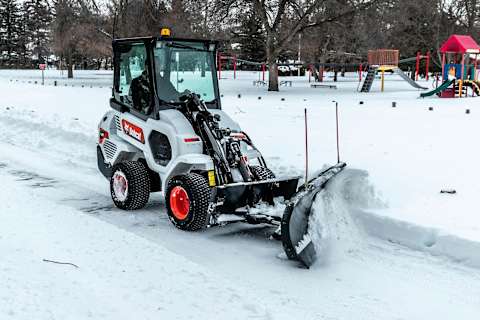
Which snow attachment fits which site?
Each attachment answers a different constraint. Describe your typical storm, your worst storm, and the physical limits of your site to your Bobcat dealer, and ask for a demonstration on your own ground before the season starts.
| Site and storm profile | Straight snow blade | Snow V-blade | Snow blower |
|---|---|---|---|
| Routine snowfall, storage space beside route | Strongest fit | Workable | Over-specified |
| Long runs, repeated passes, speed matters | Strongest fit | Workable | Slower |
| Drifts and hard-packed accumulations | Limited | Strongest fit | Workable |
| Snow must be gathered and stacked | Limited | Strongest fit | Workable |
| Narrow routes, no storage, growing banks | Limited | Limited | Strongest fit |
| Snow must leave the site by truck | Not suitable | Limited | Strongest fit |
| Gravel or decorative surfaces | Workable with correct edge and shoes | Workable with correct edge and shoes | Workable with shoes set high |
| Bonded ice | Not suitable | Not suitable | Not suitable |
Customer Experience
Emphasizing operational flexibility across diverse municipal environments and open roadways, Mayor Alfredo Gaspar highlighted:
"We chose Bobcat over all the other brands because the surrounding municipalities have Bobcat equipment and are very satisfied. The Bobcat L28 loader is used both in urban environments and in the surrounding open terrain."
FAQ – Frequently Asked Questions
Is a straight blade always faster than a V-blade?
In routine snowfall on open routes with storage space beside them, an angled straight blade is usually quicker because it is simpler and lighter. That advantage narrows in drifts, in heavy wet accumulations, and on sites where snow has to be gathered rather than pushed aside.
Can any loader with hydraulics run a snow blower?
No. A blower needs auxiliary flow and pressure matched to continuous operation, adequate cooling and return capacity, and an electrical connection for the chute controls. Check the full hydraulic specification against the attachment requirement, not just the couplers.
Will a snow blower clear ice?
A snow blower is designed for snow, not for ice bonded to the surface. For packed ice and compacted layers, use a scraper attachment or a treated surface instead. Bobcat positions its scraper attachment as an alternative to chemicals or salt for dislodging packed snow and ice.
How do I avoid damaging gravel, block paving, or turf?
Surface protection comes from three settings: skid or depth shoes, float, and cutting edge. An optional rubber cutting edge is available on selected Bobcat snow blade and snow V-blade widths for paved and decorative surfaces, and shoes should be set higher on gravel so the edge does not collect stone.
Does a wider attachment always clear more per hour?
Not necessarily. A wider path only helps if your loader has the weight, traction, and power to push a full blade—and if the route is wide enough to fit it. On a smaller machine, an oversized attachment can actually make it harder to steer and force you to slow down.
What maintenance should I plan for across a winter season?
Keep an eye on the cutting edge and flip or replace it when it gets worn. Check your trip springs and skid shoes if you clip a curb or a manhole cover, and keep an eye on your hydraulic fluid and cooling if you're running a blower for long stretches.
Sources and Further Reading
Disclaimer
This content is provided for general informational and guidance purposes only. It may not reflect the specific requirements, conditions, configurations, attachments, applications, terrain, weather, or operating environment relevant to every machine or situation. Any models, configurations, availability, features, and specifications mentioned are provided for illustrative purposes only and may vary by market, region, dealer, and time. Operators, owners, and customers should always assess the actual working conditions and refer to the applicable operator’s manual, service manual, technical documentation, safety instructions, and product specifications for the specific Bobcat model and equipment being used. They should also consult an authorized Bobcat dealer or qualified professional before making operational, maintenance, purchasing, or safety-related decisions.