- Home
- Buyer's Guides
- Product Buyer's Guides
- Turf Renovation Equipment: A Buyer's Guide for Golf and Sports-Field Teams
Turf Renovation Equipment: A Buyer's Guide for Golf and Sports-Field Teams
Published on: 11 September 2026
In this article:
- Diagnosing compaction, thatch depth, and turf density before buying determines which category of turf renovation equipment you actually need.
- Bobcat aerators, dethatchers, the DT20 dethatcher-overseeder, and sod cutters each solve a different turf problem rather than offering variations on one machine.
- Renovation frequency, storage, and cleanup capacity help you decide whether owning equipment makes more sense than renting or contracting the work.
Compacted soil, a thatch layer that will not clear, thin turf that will not establish, and a surface that needs re-laying are four different problems. Bobcat's turf renovation range covers them with four different machines: aerators, dethatchers, the dethatcher-overseeder, and sod cutters. This guide works from the problem to the machine, and then to the ownership question.
Which turf problem are you actually solving?
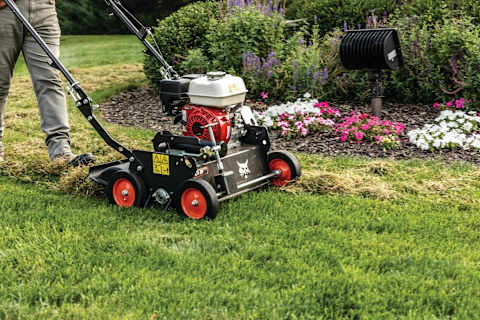
Which turf problem are you actually solving?
A green that drains poorly, a fairway with weak density, and a pitch with a thick thatch layer look similar from a distance and call for entirely different operations. Shopping by category name before confirming what is happening beneath the surface is how the wrong machine ends up in the shed. Soil depth, thatch thickness, and rooting depth tell you which category you need.
Bobcat’s turf equipment range is organized around those specific needs. Aerators relieve compaction, dethatchers and the dethatcher-overseeder manage thatch and rebuild density, and sod cutters remove or reinstate turf entirely. By diagnosing the problem first, you can invest in the right machine once, avoiding the need to rethink your equipment list later.
Check each of the following before choosing a machine:
- Soil compaction and infiltration, tested with a probe or a screwdriver check.
- Thatch depth and organic matter build-up at the surface.
- Turf density and how well previous seed has established.
- Drainage performance during and after heavy rainfall.
- Available carrier, storage space, and crew capacity for cleanup.
Aerators: relieving compaction without wrecking the surface
Compaction restricts air, water, and root growth, which is one of the most common reasons golf greens and sports pitches lose vigor. Bobcat walk-behind aerators use cast-iron tine wheels and a sturdy frame to punch consistently through compacted ground without the tines lifting. Easy Steer Technology (EST) keeps them maneuverable around sprinklers, bunkers, and touchlines.
Two frame sizes allow you to match aeration intensity to the size and sensitivity of the area, rather than accepting either wasted time or excessive disruption by using the same machine everywhere.
- AE19: A compact walk-behind aerator for clubhouse surrounds, small areas, and tight access.
- AE26: A larger walk-behind aerator built for expansive lawns and full-size sports facilities.
Dethatchers and the dethatcher-overseeder: managing thatch and rebuilding density
Some organic layer is normal and functional. The concern is excessive build-up that traps moisture and weakens the surface. Overseeding after aggressive dethatching frequently fails for a single reason: the seed never achieves proper contact with soil.
Bobcat dethatchers use adjustable cutting-depth controls, so you can verticut and lift thatch without tearing into the healthy grass beneath it. The DT20 dethatcher-overseeder goes further and combines thatch removal with seed placement in one walk-behind pass, putting seed down while the surface is still open. With a straightforward dethatcher and a combined dethatcher-overseeder in the same range, the renovation programme and the establishment step can be planned together instead of as two separate purchases.
- DT18: Dethatching and verticutting for general turf maintenance.
- DT19: Heavier-duty dethatching for larger areas and more demanding renovation work.
- DT20 dethatcher-overseeder: thatch removal combined with seed placement in a single pass.
Sod cutters: precise turf removal without wasted labour
Sometimes the turf itself has to come out, not just the soil beneath it. Worn goal-mouths, failed drainage repairs, and full green reconstructions all start with clean sod removal, and a ragged strip creates rework that erases any time saved on cutting speed.
Bobcat sod cutters combine cutting-depth control with a cast-iron housing gearbox and are engineered to the tolerances expected on leading golf courses. They lift sod in consistent, even strips that can be relaid or replaced without trimming the edges by hand afterwards.
Matching the machine to greens, fairways, and sports pitches

Matching the machine to greens, fairways, and sports pitches
One tine size, one cutting depth, and one work rate will not suit every zone on a site, which is why each Bobcat turf equipment category contains more than one model rather than a single general-purpose unit. Working across greens, tees, and fairways, or across several pitches, means selecting different models or different settings on the same model for each surface.
| Surface | What matters most | Typical choice |
|---|---|---|
| Greens and tees | Minimal rutting, high uniformity, disruption timed to protect putting quality | AE19 aerator, DT18 dethatcher, SC12 sod cutter |
| Fairways and large lawns | Work rate across a large area, where a higher rate is acceptable | AE26 aerator, DT19 dethatcher, SC18 sod cutter |
| Sports pitches | Intensity balanced against a fixed fixture list, with seed established before the next match | AE26 aerator, DT20 dethatcher-overseeder, SC18H sod cutter |
Matching the right model to the specific surface keeps your renovation program running across the entire site without compromising one area to suit another.
Plan for labour and cleanup before the machine arrives
Aeration cores, removed thatch, and cut sod all have to go somewhere. Crews without the equipment or labour to collect and process debris end up defaulting to lower-disruption operations, or leaving material on a surface that is needed for play. Cleanup capacity shapes equipment choice as much as the renovation task itself.
Size the collection and loading workflow alongside the renovation machine. The fastest aerator or dethatcher gains nothing if the debris cannot be cleared before the surface is back in use.
- Aeration cores: Collection, breaking down, and disposal or reincorporation.
- Removed thatch: Sweeping, drag matting, and loading for disposal.
- Cut sod: Lifting, transporting, and either relaying or removing from the site.
Buy, rent, or contract? Choosing the right ownership model
Specialist turf renovation equipment is hard to justify at low annual use, particularly when a qualified contractor can complete a disruptive operation inside a short weather window. Renovating several times a year across multiple surfaces justifies ownership faster than a single annual programme, where renting or contracting the work is usually more practical.
- Use frequency: multiple renovation projects a year favours ownership; one annual programme often favours renting.
- Carrier and storage: confirm suitable storage and transport are already available before buying.
- Staff skill and support: Check that operators are trained and that technical support is available if a machine goes down mid-season.
- Shared access: neighbouring clubs or facilities can sometimes split the cost of infrequently used equipment.
FAQ – Frequently Asked Questions
How do I know whether my turf problem needs an aerator or a dethatcher?
Compaction, poor drainage, and weak root growth point to an aerator, while a spongy surface and a visible thatch layer point to a dethatcher. Inspecting soil and thatch depth before buying avoids choosing the wrong category.
What is a dethatcher-overseeder, and do I need one instead of a standard dethatcher?
A dethatcher-overseeder, such as the Bobcat DT20, removes thatch and places seed in the same pass. It suits renovation programmes where establishing new grass is the goal, whereas a standard dethatcher is enough if thatch management alone is required.
Are Bobcat sod cutters suitable for golf-course standard work?
Yes. Bobcat sod cutters are engineered to the tolerances expected on leading golf courses, and the SC18H adds a hydrostatic transmission for smoother control on larger cutting jobs.
Does more organic matter in the turf always mean I should dethatch aggressively?
No. Some thatch is functional, and treatment intensity should be based on measured thatch depth and turf growth rather than applied as a routine, universal operation.
How much disruption should I expect from aeration or dethatching?
Disruption depends on the aggressiveness and depth of the operation chosen, not on the category of machine alone. Lower-disruption options exist within both the aerator and dethatcher ranges, so intensity can be matched to the surface and its recovery window.
Is it better to buy turf renovation equipment outright or use a contractor?
It depends on utilisation. Frequent, multi-surface renovation programmes tend to justify ownership, while occasional or single-surface work is often more practical to rent or contract, especially where the job must fit a short weather window.
Sources and Further Reading
Disclaimer
This content is provided for general informational and guidance purposes only. It may not reflect the specific requirements, conditions, configurations, attachments, applications, terrain, weather, or operating environment relevant to every machine or situation. Any models, configurations, availability, features, and specifications mentioned are provided for illustrative purposes only and may vary by market, region, dealer, and time. Operators, owners, and customers should always assess the actual working conditions and refer to the applicable operator’s manual, service manual, technical documentation, safety instructions, and product specifications for the specific Bobcat model and equipment being used. They should also consult an authorized Bobcat dealer or qualified professional before making operational, maintenance, purchasing, or safety-related decisions.