- Home
- Buyer's Guides
- Product Buyer's Guides
- Which Mower Is Right for Your Large Lawn, Sports Field, or Estate?
Which Mower Is Right for Your Large Lawn, Sports Field, or Estate?
Published on: 3 September 2026
In this article:
- Learn why site conditions, rather than simple acreage, should drive your mower choice.
- Understand how cutting width, engine power, and deck design function as a single system.
- Match mulching, discharge, or collection methods to your specific site and validate your shortlist before buying.
Buyers often start with one number: total acreage. However, acreage rarely predicts whether a mower will actually perform on-site. What matters is its ability to cover open ground efficiently while fitting through gates, following contours, and remaining stable near slopes, ponds, or wet ground.
Match the Platform to the Site
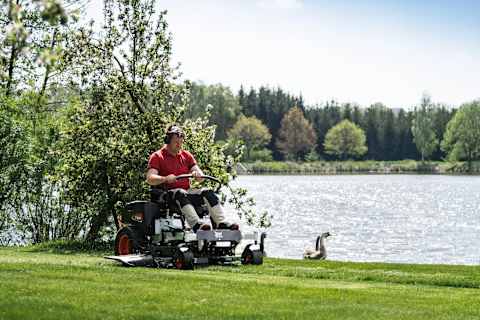
Match the Platform to the Site
A mower isn't just one product; it's a family of platforms designed for various terrain types.
| Platform | Best suited to |
|---|---|
| Ride-on zero-turn mower | Navigates open, level, or gently sloping ground with ease. |
| Stand-on zero-turn mower | Provides agility for tighter, more contoured landscapes. |
| Walk-behind mower | Fits perfectly in confined or narrow-access areas. |
| Mower attachment for tractors and loaders | Handles rougher clearance work alongside fine turf maintenance. |
Bobcat covers this range with ride-on and stand-on zero-turn mowers, a walk-behind mower, and mower attachments that fit compact tractors and loaders for rougher ground.
Map the Site Before Comparing Specs
The actual mowable area is usually smaller than the total land size once you exclude buildings, ponds, and inaccessible areas. Before comparing machines, identify:
- The actual mowable area, not total land size.
- Slopes, banks, and any wet ground.
- Gate widths and other fixed obstacles.
- The finish standard needed per zone: general amenity or tighter sports cut.
Mapping these details turns a vague acreage figure into a practical specification.
Check Width and Power Against the Whole Job
While a wider deck cuts mowing time in theory, it fails if it cannot clear gates or follow contours without scalping the turf. Engine power is similar: a high horsepower rating means little if the deck, drivetrain, and cooling systems cannot sustain it during heavy growth. Evaluate:
- Cutting width against your narrowest access point, not total area.
- Whether the deck follows contours or relies on one rigid platform.
- Engine and drivetrain performance under sustained, heavy growth.
Bobcat mowers pair Kawasaki engines with fabricated steel decks designed for maximum airflow and consistent discharge. They also feature Hydro-Gear® hydrostatic transaxles that maintain power delivery under load. The rotary decks used throughout the range support a wide cutting-height range, which influences finish quality more than the cutting mechanism itself. Choose the widest deck that fits your site and pair it with an engine and drivetrain capable of handling your toughest growth.
Choose Mulch, Discharge, or Collect

Choose Mulch, Discharge, or Collect
The right choice depends on your aesthetic expectations, mowing frequency, grass moisture, and proximity to people or property.
- Mulching cuts disposal work but struggles with heavy or wet growth, causing clogging and belt stress.
- Collection suits strict appearance needs or heavy growth, but at the cost of extra unloading time.
- Discharge is efficient but needs careful direction control near paths and people.
Bobcat mowers offer customizable decks and mulching kits. Additionally, flail and finishing mower attachments provide the same flexibility for compact tractors and loaders on estates with a mix of rough and fine turf.
Weigh Total Cost, Not Just Price
Downtime during peak season can quickly erase the productivity gains of a larger deck or engine. Before finalizing your purchase, consider:
- Purchase against lease options.
- Total cost of ownership, not just sticker price.
- How fast the operation recovers from a breakdown mid-season.
- Local parts and workshop access.
Bobcat mowers feature accessible service points, and the extensive EU dealer network ensures that a breakdown is merely a minor delay rather than a lost season.
Validate on Site Before You Sign
A spec sheet cannot prove how a mower will behave on your specific terrain. Test the following on-site:
- The narrowest gate or access point.
- A genuinely heavy, overgrown patch of grass.
- The mulching or collection system under real conditions.
- Service access.
Always check slope and bank performance against the manufacturer's stated operating limits. Ride-on equipment safety on slopes is a critical risk area documented in official health and safety guidance. If a slope or wet zone falls outside those limits, plan for a different machine or designate an exclusion zone.
Conclusion
No single platform or deck width fits every large lawn, sports field, or estate. The ideal choice connects site mapping, platform selection, cutting strategy, and ownership cost. Always confirm your choice with a real-world demonstration on your own ground before you sign.
FAQ – Frequently Asked Questions
How do I determine what size mower I need?
Map the mowable area rather than the total land size. Consider slopes, wet zones, gates, and the desired finish for each zone before comparing deck sizes.
Will a wider deck save time on a large property?
Only if it clears your gates and follows contours without scalping. Check width against your narrowest access point first.
Does more engine power guarantee a better cut?
No. Deck airflow, drivetrain performance, and cooling matter as much as raw output under load.
Should I mulch, discharge or collect?
It depends on moisture, mowing frequency, appearance needs, and proximity to people or property. Mulching suits light, regular growth; collection suits heavier growth or strict appearance standards; discharge needs direction control.
Can any mower handle slopes safely?
Not necessarily. Check slope and bank performance against the manufacturer's stated limits. Steep or wet ground may need a different machine or an exclusion zone.
What should I check before buying?
A demonstration on your own site covering the narrowest gate, a heavy grass patch, the clipping system, and service access.
Are mower attachments for tractors or loaders worth it on estates?
Yes, where a site combines rough banks or verges with fine turf. They extend an existing tractor or loader fleet instead of adding a dedicated ride-on mower.
Sources and Further Reading
- Bobcat Mowers
- Bobcat ZT2000 Zero-Turn Mower
- Bobcat ZT3000 Zero-Turn Mower
- Bobcat ZT3500 Zero-Turn Mower
- Bobcat ZT6000 Zero-Turn Mower
- Bobcat ZS4000 Zero-Turn Stand-On Mower
- Bobcat Mower Attachment
- Bobcat Finishing Mower
- Bobcat Flail Mower, Self-Levelling
- Bobcat Launches New Line of Mowers for Professional Use
Disclaimer
This content is provided for general informational and guidance purposes only. It may not reflect the specific requirements, conditions, configurations, attachments, applications, terrain, weather, or operating environment relevant to every machine or situation. Any models, configurations, availability, features, and specifications mentioned are provided for illustrative purposes only and may vary by market, region, dealer, and time. Operators, owners, and customers should always assess the actual working conditions and refer to the applicable operator’s manual, service manual, technical documentation, safety instructions, and product specifications for the specific Bobcat model and equipment being used. They should also consult an authorized Bobcat dealer or qualified professional before making operational, maintenance, purchasing, or safety-related decisions.