- Home
- Buyer's Guides
- Product Buyer's Guides
- Compact Wheel Loader ROI: Getting Year-Round Work from the Bobcat L85 and L100
Compact Wheel Loader ROI: Getting Year-Round Work from the Bobcat L85 and L100
Published on: 2 November 2026
In this article:
- Why year-round use sets the return on investment for a compact wheel loader.
- How the Bobcat L85 and L100 compare on size, hydraulics, and travel speed.
- What to check with your dealer before signing.
A compact wheel loader only pays for itself while working. An idle machine continues to depreciate and requires insurance, so the more seasons it covers, the lower the cost per job. This guide shows how the Bobcat L85 and L100 compact wheel loaders stay busy from spring site work to winter snow removal.
Why does year-round use decide the return?

Why does year-round use decide the return?
Purchase price, financing, insurance, and depreciation are fixed costs. Spread across more operating hours, each hour costs less. A loader that only clears snow or only operates during the summer carries those costs for months without generating revenue.
A Bobcat compact wheel loader shifts roles by swapping attachments. Confirm attachment compatibility for your specific model with your dealer.
| Season | Typical work | Bobcat attachments |
|---|---|---|
| Spring | Site preparation, leveling, landscaping, and augering | General purpose bucket, combination bucket, self-leveling planer, and auger |
| Summer | Loading trucks, pallet handling, recycling, and asphalt work | Pallet forks, light material bucket, and soil and asphalt spreader |
| Autumn | Farmyard handling, site cleanup, and sweeping | Farm grapple-utility bucket, angle broom, sweeper, and pressure washer |
| Winter | Municipal snow removal, gritting, and snow loading | Snow blade, snow V-blade, snow pusher, snow blower, and salt and sand spreader |
Customer Experience
Stone contractors demonstrate how a single loader earns its keep across all four seasons. Andreas Nilsson, owner of Strixen AB in Sweden, describes how his Bobcat L95 compact wheel loader moves between the jobsite, the production hall, and winter operations:
"On jobsites, it services active crews by feeding stone forward. Inside our production facility, it lifts heavy stone blocks directly onto the block saws. During winter, we fit a snow blade to plow large commercial areas."
L85 or L100: which size suits your work?
Size the loader around your heaviest regular task: a pallet of paving stones, loading over the side of a truck, or getting through a barn door. If you are between sizes, the larger machine leaves room for future work.
The L85 suits loading in restricted spaces. The L100 has a larger bucket and more engine power. Both use a Z-kinematics lift arm for high breakout force and stability under load, while Auto Ride Control keeps the bucket or forks steady during travel.
| Specification | L85 (2026 update) | L100 |
|---|---|---|
| Engine power | 50.7 kW (68 hp) | 55.2 kW (74 hp) |
| Operating weight | 4,796 kg | 5,258 kg |
| Bucket capacity | 0.8 m³ | 1.0 m³ |
| Lift height | 3.3 m | 3.3 m |
| Overall width | 1,800 mm | 1,807 mm |
| Auxiliary pressure | 235 bar | 235 bar |
| High Flow (optional) | Up to 103.5 l/min | Up to 103.5 l/min |
| Selectable top speed | 20, 30, or 40 km/h | 20, 30, or 40 km/h |
| Towing hitch (optional) | Up to 3.5 t | Up to 3.5 t |
Pick the L85 for narrow access and tight yards, and the L100 for high-volume loading and heavier pallets.
How do attachments and hydraulics keep one machine working?
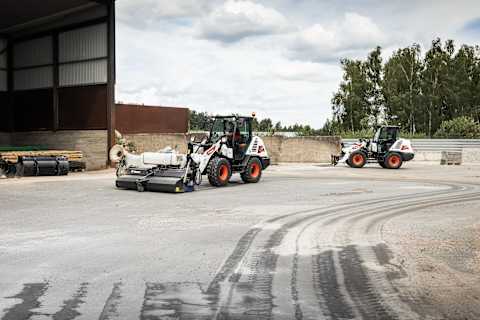
How do attachments and hydraulics keep one machine working?
Snow blowers, planers, and sweepers need strong hydraulic flow and a slow, steady travel speed, and you will want to keep using the attachments you already own. On the L85 and L100:
- The standard hydraulic quick coupler fits common wheel loader coupler types, allowing existing attachments to remain in service.
- An optional Bob-Tach™ interface lets you share attachments with Bobcat skid-steer loaders and compact track loaders, at the cost of some maximum load capacity.
- Optional High Flow and higher auxiliary pressure give more tilt breakout force and stronger attachment performance.
- The joystick controls multiple attachment functions without requiring the operator to release their grip.
- The premium display recognizes attachments automatically and sets a low work-mode travel speed while engine speed stays high for brooms and blowers.
Should you choose 20, 30, or 40 km/h?
Slow transit between jobsites or farm parcels wastes hours every week. Faster machines can require additional compliance: in Germany, a self-propelled machine limited to 20 km/h needs no registration or periodic inspection, whereas faster machines require registration, separate insurance, and the appropriate driver’s license class.
The L85 and L100 can be ordered with top speeds of 20, 30, or 40 km/h, and an approved towing hitch allows the loader to tow a trailer between jobs. Municipal fleets and multi-site operations benefit from higher-speed configurations. If operations center on a single yard, a 20 km/h speed limit keeps compliance simple. Your dealer can confirm local regulations in your area.
Customer Experience
Andreas Nilsson also explains why speed matters on large winter contracts:
"Transport speed is vital. Having a 40 km/h travel capability saves significant operational hours during winter snow removal across large properties."
Can a compact wheel loader handle winter municipal work?
Packed snow, cold starts, steep inclines, and heavy plow blades present major winter challenges. Winter tires or chains, adequate machine weight, and proper attachments make the biggest impact.
The L85 and L100 feature a heated cab and automatic parking brake as standard equipment, while slope assist helps maintain position on inclines. An optional differential lock and extra counterweight enhance traction when pushing heavy snow loads.
The salt and sand spreader also distributes fertilizer and seed, making it valuable during spring as well.
What protects your investment after purchase?
Dealer distance, parts costs, and resale value shape what the loader costs over its working life.
The L85 and L100 come equipped with Machine IQ® telematics for remote diagnostics, fault codes, and remote engine lockout, helping your dealer address small issues early. A single service point, integrated greasing points, on-screen maintenance reminders, and a reversible cooling fan make daily maintenance quicker.
Before you sign:
- Test the machine on your own site with your heaviest pallet and highest truck.
- Check that the coupler fits your existing attachments.
- Choose the travel speed to match your national road rules.
- Specify High Flow if you plan to run more demanding attachments.
- Ask about Machine IQ® packages and Protection Plus terms.
- Check the location of your nearest Bobcat dealer and available service support.
FAQ – Frequently Asked Questions
What is the main difference between the Bobcat L85 and L100?
The L85 is built for loading in restricted spaces. The L100 has a larger bucket and more engine power. Both share the same lift height, top speed options, and attachment capability.
Can one compact wheel loader work in all four seasons?
Yes, with the right attachments. Bobcat offers compact wheel loader attachments for site preparation, material handling, sweeping, and snow removal.
Will my existing attachments fit?
The standard hydraulic quick coupler fits common wheel loader coupler types, and a Bob-Tach™ interface is available for sharing attachments with Bobcat skid-steer loaders and compact track loaders. Confirm compatibility with your dealer before ordering.
Do I need High Flow for snow work?
High Flow is designed for demanding hydraulic attachments such as snow blowers and planers. Your dealer can tell you which of your attachments need it.
How does travel speed affect running costs?
Faster versions save travel time but may require registration, insurance, and a specific driver’s license, depending on national regulations. A 20 km/h machine simplifies paperwork if operations remain primarily on a single site.
How can I see how much my loader is used?
Machine IQ® telematics gives remote access to machine data, diagnostics, and fault codes, which helps you plan maintenance and track use.
Sources and Further Reading
- Compact Wheel Loaders
- L100 Compact Wheel Loader
- L85 Compact Wheel Loader (2026 update)
- L85 Compact Wheel Loader
- Bobcat Upgrades Compact Wheel Loader Portfolio
- Bobcat is Entering the European Wheel Loader Market
- Bobcat’s L85 Wheel Loader Gets to Work at Spanish Paper Recycling Center
- Mastering Winter Challenges: A Customer Experience with the Bobcat L85
- Compact Wheel Loaders for Construction
- Compact Wheel Loaders for Agriculture
- Compact Wheel Loader Attachments
- Salt & Sand Spreader
- Snow Blower
- Protection Plus Extended Warranty
- Bobcat’s Machine IQ Telematics Exceeds 30,000 Units Sold in Europe
Disclaimer
This content is provided for general informational and guidance purposes only. It may not reflect the specific requirements, conditions, configurations, attachments, applications, terrain, weather, or operating environment relevant to every machine or situation. Any models, configurations, availability, features, and specifications mentioned are provided for illustrative purposes only and may vary by market, region, dealer, and time. Operators, owners, and customers should always assess the actual working conditions and refer to the applicable operator’s manual, service manual, technical documentation, safety instructions, and product specifications for the specific Bobcat model and equipment being used. They should also consult an authorized Bobcat dealer or qualified professional before making operational, maintenance, purchasing, or safety-related decisions.