- Home
- Buyer's Guides
- Product Buyer's Guides
- Key Attachments for Telehandlers (Buckets, Forks, Winches) and Their Use Cases
Key Attachments for Telehandlers (Buckets, Forks, Winches) and Their Use Cases
Published on: 18 May 2026
Choose attachments around the work your telehandler does every day. Forks may handle the core lifting, but the right bucket, bale handler, jib, winch, sweeper, or approved platform can remove a bottleneck or replace another machine. Before you buy, confirm that the attachment is approved for your exact carrier and capacity chart.
In this article:
- How to choose between forks, buckets, bale handlers, jibs, winches, sweepers, and work platforms
- Why mounting interface, hydraulic flow, and attachment-specific load charts matter
- A practical attachment-to-task table for construction, agriculture, and material handling
Start With the Mounting Interface
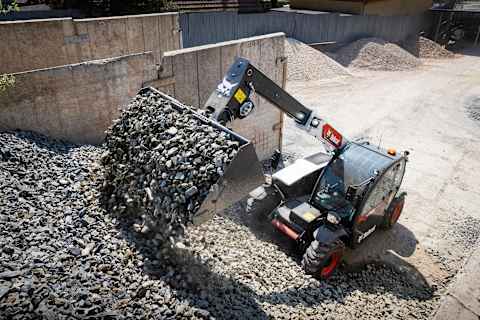
Start With the Mounting Interface
Start with the interface on your machine. The Super Compact TL25.60 uses Bob-Tach and works with a wide selection of approved Bobcat loader attachments. Most larger standard telehandlers use Quick-Tach, while Bobcat rotary telehandlers use Quick-Fit with RFID recognition.
Before you choose an attachment, confirm:
- Your machine model and carriage interface
- Mechanical, hydraulic, and electrical compatibility, including auxiliary flow, pressure, and controls
- Auxiliary flow and pressure requirements
- Attachment weight and the resulting load center
- The approved load chart or capacity information for the exact configuration
- Any required electrical connection or control system
Pallet Forks: Rigid, Floating, and Side-Shift Options
Pallet forks are the everyday starting point for building materials, bagged products, timber, farm supplies, and general palletized loads.
Choose rigid forks for predictable, prepared surfaces, and opt for floating forks when working on rough or uneven ground across construction sites. Bobcat floating forks remain level with the ground and seamlessly adapt to irregular surfaces.
Need fine alignment at the landing point? A side-shift carriage can help, but it changes the attachment configuration and may affect capacity. On selected Bobcat SLP construction telehandlers, the integrated Boom Positioning System moves the boom laterally without adding a separate side-shift carriage.
Buckets: Choose by Density and Material Behaviour
Match the bucket to the material - its density, volume, abrasion, and whether it needs to be clamped.
- Light material bucket: High-volume, low-density materials such as grain, mulch, snow, straw, and similar loose products.
- Digging or construction bucket: Denser material and light digging or loading tasks. It uses a stronger structure and lower volume than a light material bucket.
- Grapple bucket: Loose, irregular, or unstable materials such as silage, brush, scrap, waste, or demolition debris. The hydraulic grapple secures the load during travel and tipping.
- Waste or industrial bucket: High-cycle handling of loose waste and recycling material where wear resistance and retention are important.
Customer Experience
In multi-purpose setups, a high-utility bucket configuration often serves as the daily operational backbone of the yard. Farmer Christophe André highlights the immense value of keeping a flexible bucket format on his machinery fleet:
"We mainly use the multi-purpose bucket with our telehandler because it is incredibly versatile."
Before you fill the bucket, account for its own weight, the material density, and the forward load center. A high-volume bucket filled with unexpectedly dense material can exceed the machine's permitted capacity.
Bale Handlers: Match the Tool to the Bale
For wrapped silage, choose an attachment that protects the film. Bobcat's bale handler with tubes uses rounded hydraulic arms to grip one or two round wrapped bales, depending on attachment size and machine compatibility.
For unwrapped hay or straw, bale forks, spikes, or handlers with tines may be suitable. The selection depends on bale shape, size, weight, wrap condition, and whether one or two bales will be carried.
Customer Experience
Using specialized bale clamps helps operators safely stack materials higher in buildings with low overhead clearance. Christophe André explains how this works when maximizing his barn storage space:
"We use the bale clamp to stack bales up to six high, which is essential for maximizing our vertical storage space."
Check the hydraulics as well as the shape of the tool. Tube handlers and some clamps need auxiliary flow, so confirm the hose kit, couplings, flow, and control method before you buy.
Jibs and Winches for Suspended Loads

Jibs and Winches for Suspended Loads
Use a jib when the load must hang below a lifting point rather than sit on forks. Add a hydraulic winch when you need to raise or lower the load without moving the boom. Typical jobs include roof trusses, structural components, panels, and packaged plant equipment.
Customer Experience
Utilizing a tailored jib attachment dramatically reduces handling cycles compared to slower, conventional crane configurations in restrictive zones. Ornamental tree and Mediterranean plant nursery manager Ponç Carreras explains the efficiency gained when moving delicate, oversized specimens through tight spaces with their Bobcat TL43.80HF telehandler:
"Using a telehandler is much faster and more efficient than a traditional crane for moving large plants."
They use the jib to load trees onto the truck.
Suspended loads can swing and change the effective radius. Use the attachment-specific chart and follow the required lift plan, exclusion zone, and local training rules.
Do not treat a telehandler as an automatic crane replacement. The lift must stay inside the approved capacity and working envelope for the exact machine, attachment, stabilizer setup, and radius.
Work Platforms and Personnel Lifting
Never raise people on bare forks or an improvised pallet. Use only an approved work platform on a machine and procedure permitted for personnel elevation.
Bobcat offers fixed, rotating, and extendable platforms for selected machines. On current rotary telehandlers, Quick-Fit and RFID recognition identify the approved platform and load the relevant chart. Compatibility on standard telehandlers varies by model.
Local legislation, risk assessment, emergency lowering procedures, inspection requirements, and operator competence must all be addressed before lifting people.
Sweepers and Other Powered Attachments
Powered attachments extend what one carrier can do. Sweepers clean yards and access roads, while grapples, clamps, mixers, and other tools add specialized functions. All depend on the correct auxiliary hydraulic flow and pressure.
Customer Experience
Replacing slow manual labor with a hydraulic attachment can completely transform a farm's daily schedule. Poultry producer David Derenne outlines the dramatic time savings he achieved after switching to a specialized bedding bucket:
"This specialized bucket with dual hydraulic motors and side-opening drawers makes spreading material efficient, replacing a laborious, two-day manual task."
Since receiving this equipment, he has been able to complete the bedding of the three buildings in a single day.
Match the attachment specification to the machine circuit. Too little flow makes the tool slow; excessive or incorrect flow can create heat, wear, or unsafe behavior. Check the required return line and electrical controls as well.
Attachment-to-Task Guide
| Attachment | Best suited to | Key check before use |
|---|---|---|
| Rigid pallet forks | Flat yards, warehouses, palletized loads | Load center and residual capacity |
| Floating pallet forks | Rough construction and farm surfaces | Correct fork width and approved carriage |
| Light material bucket | Grain, straw, mulch, snow | Material density and bucket volume |
| Digging/construction bucket | Soil, sand, dense loose material | Breakout load and ground conditions |
| Grapple bucket | Silage, brush, scrap, demolition waste | Auxiliary flow and clamp control |
| Bale handler with tubes | Wrapped round silage bales | Bale diameter and hydraulic compatibility |
| Jib or winch | Approved suspended loads | Attachment-specific chart and lift plan |
| Sweeper | Yard and access-road cleaning | Hydraulic flow and brush width |
| Approved work platform | Personnel access at height | Machine approval, procedure, and local rules |
How Many Attachments Should a Buyer Purchase?
Build your attachment set around the utilization. Start with the tool you use every day, then add attachments that replace another machine or remove a recurring bottleneck. A construction contractor may begin with forks, a bucket, and a jib; a livestock farm may prioritize forks, a tube bale handler, and a light-material or grapple bucket.
Plan storage, transport, inspection, and wear parts at the same time. A tool that is not kept near the work area will not deliver the quick-change benefit you paid for.
FAQ – Frequently Asked Questions
Can every Bobcat telehandler use Bob-Tach attachments?
No. The TL25.60 uses Bob-Tach. Larger standard telehandlers generally use Quick-Tach, while rotary telehandlers use Quick-Fit. Always check model compatibility.
Which attachment is best for wrapped silage?
A purpose-built bale handler with rounded tubes is designed to grip wrapped round bales without piercing the film.
Do floating forks automatically stabilise a pallet?
They can adapt to uneven ground during engagement, but they do not remove the need to centre, secure, and carry the load correctly.
Does a jib reduce telehandler capacity?
It changes the load center and working configuration. Use the dedicated load chart; do not apply the standard-fork capacity.
Can a work platform be fitted to any telehandler?
No. The machine, platform, controls, and procedure must be specifically approved for personnel elevation.
Sources and Further Reading
- Bobcat Telehandler Attachments
- Bobcat Rotary Telehandler Attachments
- Bobcat Pallet Forks, Floating
- Bobcat Bale Handler With Tubes
- Bobcat Jib, Crane
- Customer Story: Christophe André and Bobcat Telehandlers
- Bobcat Telehandler Saves Time & Money in Manure Handling
- Bobcat telescopic loader TL43.80HF AGRI, versatility between olive trees
Disclaimer
This content is provided for general informational and guidance purposes only. It may not reflect the specific requirements, conditions, configurations, attachments, applications, terrain, weather, or operating environment relevant to every machine or situation. Any models, configurations, availability, features, and specifications mentioned are provided for illustrative purposes only and may vary by market, region, dealer, and time. Operators, owners, and customers should always assess the actual working conditions and refer to the applicable operator’s manual, service manual, technical documentation, safety instructions, and product specifications for the specific Bobcat model and equipment being used. They should also consult an authorized Bobcat dealer or qualified professional before making operational, maintenance, purchasing, or safety-related decisions.