- S100 Skid-Steer Loader
S100 Skid-Steer Loader
With the Bobcat S100 in your corner, you have a "tiny but mighty" solution for all of your industrial and daily needs.Display Full Product DetailTipping load915 kgEngine power18.2 kWOperating weight1860 kg - S450 Skid-Steer Loader
S450 Skid-Steer Loader
No turn is too tight or job too challenging for the high-torqued Stage V compliant engine on the new Bobcat S450.Display Full Product DetailTipping load1308 kgEngine power36.5 kWOperating weight2436 kg - S510 Skid-Steer Loader
S510 Skid-Steer Loader
If you're looking for an earth-mover that provides tremendous power and tons of comfort, check out the Bobcat S510.Display Full Product DetailTipping load1703 kgEngine power41 kWOperating weight2816 kg - S530 Skid-Steer Loader
S530 Skid-Steer Loader
It might be small, but the popular Bobcat S530 uses new high flow hydraulics to ensure no task is out of reach.Display Full Product DetailTipping load1823 kgEngine power41 kWOperating weight2952 kg - S550 Skid-Steer Loader
S550 Skid-Steer Loader
The Bobcat S550 is the perfect skid-steer loader for dumping over walls, backfilling or loaded flatbeds with ease and style.Display Full Product DetailTipping load1852 kgEngine power50.7 kWOperating weight2995 kg - S590 Skid-Steer Loader
S590 Skid-Steer Loader
With the Bobcat S590 skid-steer vertical-lift loader, you can reach the highest heights with more power than ever before.Display Full Product DetailTipping load1958 kgEngine power50.7 kWOperating weight3127 kg - S630 Skid-Steer Loader
S630 Skid-Steer Loader
Experience peak comfort and performance with Bobcat's S630 Skid-Steer Loader.Display Full Product DetailTipping load2023 kgEngine power55.3 kWOperating weight3553 kg - S650 Skid-Steer Loader
S650 Skid-Steer Loader
Lift heavier and higher with Bobcat's S650 Skid-Steer Loader.Display Full Product DetailTipping load2455 kgEngine power55.3 kWOperating weight3778 kg - S66 Skid-Steer Loader
S66 Skid-Steer Loader
Even the toughest jobs are a cinch with the potent and comfortable Bobcat S66 R-Series skid-steer vertical-lift path loader.
Display Full Product DetailTipping load2359 kgEngine power54.5 kWOperating weight3271 kg - S66-2 Skid-Steer LoaderNew
S66-2 Skid-Steer Loader
The S66-2 skid-steer loader brings the next step in the R-Series evolution in ways you’ll notice every day.
Display Full Product DetailTipping load2268 kgEngine power55 kWOperating weight3262 kg
Choosing a Skid-Steer Loader
Decide whether a skid-steer loader fits your work, compare it with other compact machines, and find the right guide for your next step.
- Home
- Buyer's Guides
- Choosing a Skid-Steer Loader
A skid-steer loader is a strong choice for loading, grading, site cleanup, material handling, and frequent attachment changes on firm ground. It turns within its own footprint, so it keeps working in tight farmyards, barns, and confined construction sites.
For regular deep trenching or work on very soft ground, compare a mini excavator or a compact track loader before deciding.
I’m new to skid-steer loaders
Learn how skid-steer loaders work, where they perform best, and how they differ from compact track loaders.
I’m comparing machine types
Compare skid-steer loaders with mini excavators, compact track loaders, tractors, or another machine before choosing.
I’m comparing specifications
Understand rated operating capacity, engine power, hydraulic flow, and operating weight before comparing models.
I need attachments
Choose attachments based on the job, hydraulic requirements, coupler compatibility, and working conditions.
Discover More Articles About Skid-Steer Loaders
16 Results
16 Results
Compact Wheel Loader vs. Telehandler vs. Skid-Steer Loader: Lift Height, Bucket Capacity, Versatility and Best Use Cases
Compare compact wheel loaders, telehandlers, and skid-steer loaders by reach, carrying, turning, attachments, ground conditions, and real job cycles.
Compact Tractor or Skid-Steer Loader: Which Wins Mowing and Hauling?
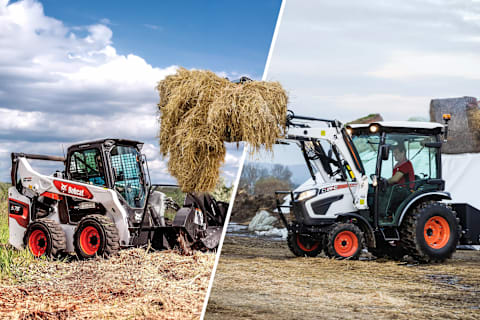
Choosing between a compact tractor and a Bobcat skid-steer loader for farm work? See how each handles mowing and hauling jobs across Europe.
Small Articulated Loader vs. Skid-Steer Loader vs. Compact Wheel Loader: How to Choose
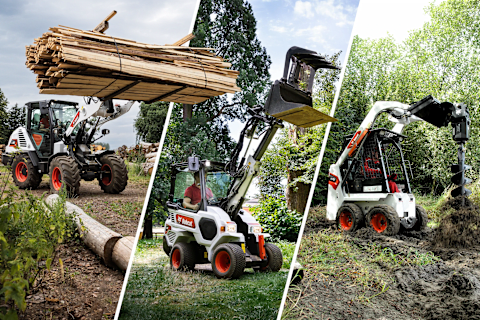
Compare small articulated loaders, skid-steer loaders, and compact wheel loaders by surface, access, loading cycle, attachments, and running cost.
Mini Track Loaders vs Skid-Steer Loaders vs Compact Track Loaders: Choosing the Right Compact Loader for Landscaping and Ground Care
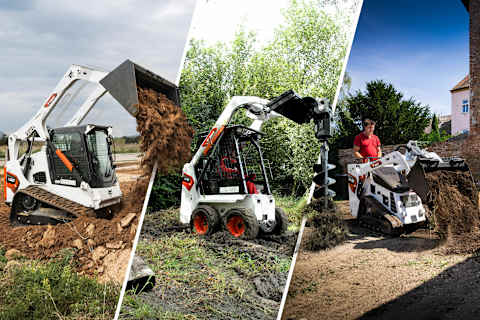
Choosing a compact loader for ground care? See how gate access, daily volume, turf damage, and undercarriage cost decide between MTL, SSL, and CTL.
Skid-Steer Loader vs Mini Excavator: A Practical Comparison
If you've been sitting on this decision for a while, you're in good company.
Skid-Steer Loader Spec Guide: ROC, Engine Power, and What the Numbers Really Mean
When you are comparing skid-steer loaders, the specification sheet can feel like a wall of figures.
Skid-Steer Loader vs. Tractor for Farm Tasks: Which Is More Efficient?
A front-loaded tractor handles many farm jobs adequately, but tight livestock buildings, narrow yard lanes, and daily repetitive tasks around bedding and bale management reveal the limits of a large machine quickly.
Skid-Steer Loader Uses: Farm and Construction Applications
Many farmers and operators ask the same question before investing in compact equipment: Can a single skid-steer loader genuinely handle both farm and construction work, or does each environment demand its own dedicated machine?
Buy, Rent, or Used? Choosing the Right Skid-Steer Loader for Your Operation
For contractors, farmers, and site managers, the choice between buying new, renting, or going used is not primarily about upfront cost.
The Right Attachment for the Job: A Skid-Steer Loader Buyer's Guide
A skid-steer loader can grade a site in the morning, handle pallets at noon, and bore post holes before the end of the day.
Skid-Steer Loader Attachments for Farming: Bale Handling, Manure Forks, and Augers
Farmers working across mixed livestock and arable operations face a daily juggling act: bale transport in the morning, barn clearing by midday, and post-hole drilling before the light fades.
Clearing, Grading, and Lifting: Choosing the Right Skid-Steer Loader Attachment
The right attachment turns a skid-steer loader into a precision tool for the task at hand.
Compare skid-steer loader models
Compare Bobcat skid-steer loader models, check specifications, or contact your local dealer for help matching a machine to your work. When comparing Bobcat skid-steer loader models, focus on rated operating capacity, operating weight, engine power, hydraulic flow, attachment requirements, and jobsite conditions.
Skid-steer loader FAQs
Is a skid-steer loader suitable for deep digging?
For occasional, shallow digging tasks, yes. When equipped with a severe-duty construction/industrial bucket or a dedicated digging attachment, it handles surface-level excavations effectively, and a radial lift path model is particularly suited to ground-level breakout work. However, if deep trenching, drainage installation, or drilling deep post holes form the core of your regular work, a mini excavator provides substantially more precision and concentrated downward digging force. For heavy work on soft or muddy ground, a compact track loader is the better choice.
What is the primary operational difference between a skid-steer loader and a compact track loader?
The undercarriage. A skid-steer loader operates on four pneumatic or solid tires. This makes it faster in transport, allows it to turn more sharply on hard, stable surfaces like concrete or asphalt, and generally results in lower acquisition, fuel, maintenance, and transport costs. A compact track loader runs on heavy-duty rubber tracks, which spread the machine's weight to maintain traction and prevent sinking on soft, muddy, snowy, or sloped ground. In return for this flotation, the tracks, rollers, and idlers require more rigorous daily inspection and represent a higher long-term replacement cost. Most Bobcat attachments are interchangeable between the two via the same coupler system, provided the hydraulic requirements are matched.
Is a skid-steer loader generally better than a mini excavator?
It depends entirely on the work you perform most frequently. A skid-steer loader is a strong all-rounder for lifting, moving bulk material, finish grading, and switching between hydraulic attachments on firm ground, typically at a lower operating cost per hour. A mini excavator is purpose-built to dig deeply below ground level, rotates a full 360 degrees, and operates much more effectively on highly confined, soft, or severely uneven sites where a loader cannot gain traction. Consequently, many professional crews choose to run both machines rather than compromise on the capabilities of one.
Which specifications matter most when choosing a skid-steer loader?
Start with the Rated Operating Capacity (ROC). This is the safe, certified working load (set at 50% of the tipping load for wheeled loaders under industry standards), and it must comfortably exceed your heaviest typical daily lift. Engine power matters primarily because it dictates the hydraulic flow and pressure the machine can generate, so evaluate the engine output against the specific attachments you plan to operate. Next, compare the lift path geometry (radial lift is superior for digging and heavy ground-level pushing; vertical lift is superior for high stacking and frequent truck loading), operating weight, and overall dimensions for site access and legal transport limits. A dealer demonstration is the most reliable way to confirm your choice.
Do I automatically need high flow hydraulics for skid-steer loader attachments?
Not for the vast majority of them. Standard tools such as general-purpose buckets, pallet forks, sweepers, and angle brooms operate perfectly on standard auxiliary flow. However, severe-duty attachments, including hydraulic breakers, most heavy-duty augers, higher-output forestry mulchers, and cold planers, need High Flow to work effectively. The most demanding industrial tools, such as large trenchers or massive milling attachments, may even require Super Flow. A hydraulic mismatch costs you money either way: insufficient flow leaves the attachment slow, underpowered, and prone to stalling, while excessive flow generates unnecessary heat, pressure, and accelerated component wear. Always compare the attachment’s specific flow and pressure requirements with your machine’s auxiliary circuit capabilities before purchasing.
How do I proactively keep downtime and fuel costs down?
Begin every single shift with a disciplined 10- to 15-minute walk-around inspection: check critical fluid levels, inspect tire condition, review the air filter restriction indicator, and clear all debris from the cooling fins and radiator. Strictly adhere to the scheduled service intervals for your specific model, insist on genuine Bobcat parts, and grease all attachment pivot pins and Bob-Tach™ wear points every 10 operating hours (or daily). Switch off the engine during longer pauses and carefully match your engine RPM to the task at hand; unnecessary idling and running at full throttle for light tasks burns fuel you do not need to spend. The Machine IQ® telematics system can monitor engine hours, fuel levels, active fault codes, and maintenance status remotely, and your local dealer can provide comprehensive BobCARE planned maintenance contracts to secure your uptime.
Disclaimer
This content is provided for general informational and guidance purposes only. It may not reflect the specific requirements, conditions, configurations, attachments, applications, terrain, weather, or operating environment relevant to every machine or situation. Any models, configurations, availability, features, and specifications mentioned are provided for illustrative purposes only and may vary by market, region, dealer, and time. Operators, owners, and customers should always assess the actual working conditions and refer to the applicable operator’s manual, service manual, technical documentation, safety instructions, and product specifications for the specific Bobcat model and equipment being used. They should also consult an authorized Bobcat dealer or qualified professional before making operational, maintenance, purchasing, or safety-related decisions.